
The phrase “Got it, thank you” is simple and useful. It shows that you received information and that you appreciate it.
However, in English communication—especially in emails, business messages, and professional settings—the words you choose create an impression.
Choosing the right phrase affects tone, clarity, politeness, and professionalism.
Using varied language also helps you avoid sounding repetitive, robotic, or too casual. It shows confidence, emotional intelligence, and fluency.
For example, in a business setting you might say “Thank you for the clarification. I understand.” while in a friendly chat you could simply say “Gotcha, thanks!”
Different situations require different expressions, and learning alternatives helps English learners sound more natural, smart, and respectful in every context—from academic essays to office chats to daily conversation.
What Does “Got It, Thank You” Mean?
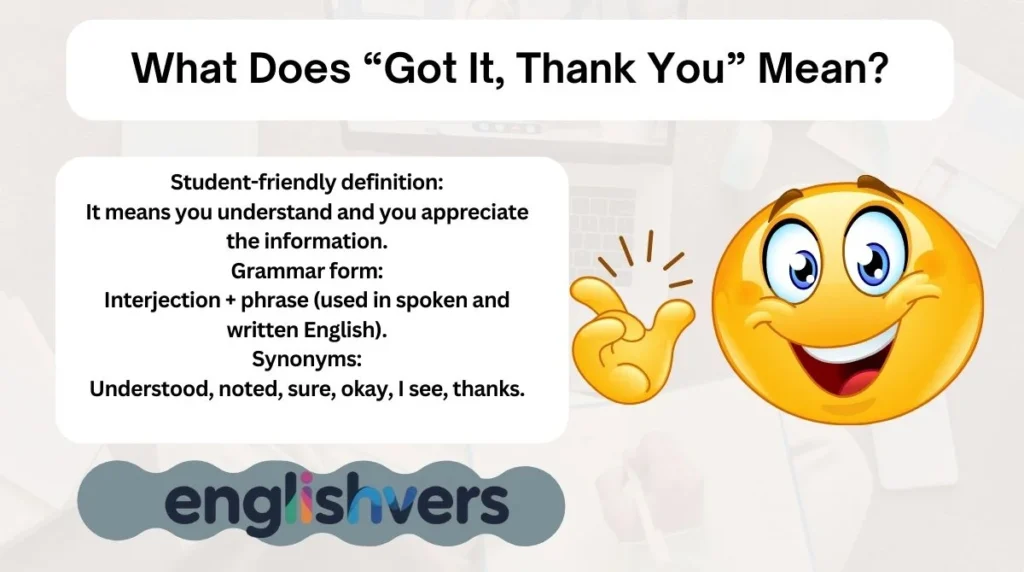
Student-friendly definition:
It means you understand and you appreciate the information.
Grammar form:
Interjection + phrase (used in spoken and written English).
Synonyms:
Understood, noted, sure, okay, I see, thanks.
Opposite tones:
I don’t understand, please repeat, not clear, I disagree.
Sample sentences:
- Got it, thank you. I’ll take care of it today.
- Got it, thanks for your help.
When to Use “Got It, Thank You”
Spoken English
Useful for quick, clear replies when someone gives instructions.
Business English
Better in short conversations or messages, not always for formal emails.
Emails / Messages
Acceptable with colleagues you know well.
Can seem too short or casual with new clients or leadership.
Social Media
Perfect for comments, DMs, or chat replies.
Academic Writing
Avoid in essays or reports; choose a formal option.
Professional Meetings
Use when confirming tasks or decisions, but add details if needed.
Is “Got It, Thank You” Polite or Professional?
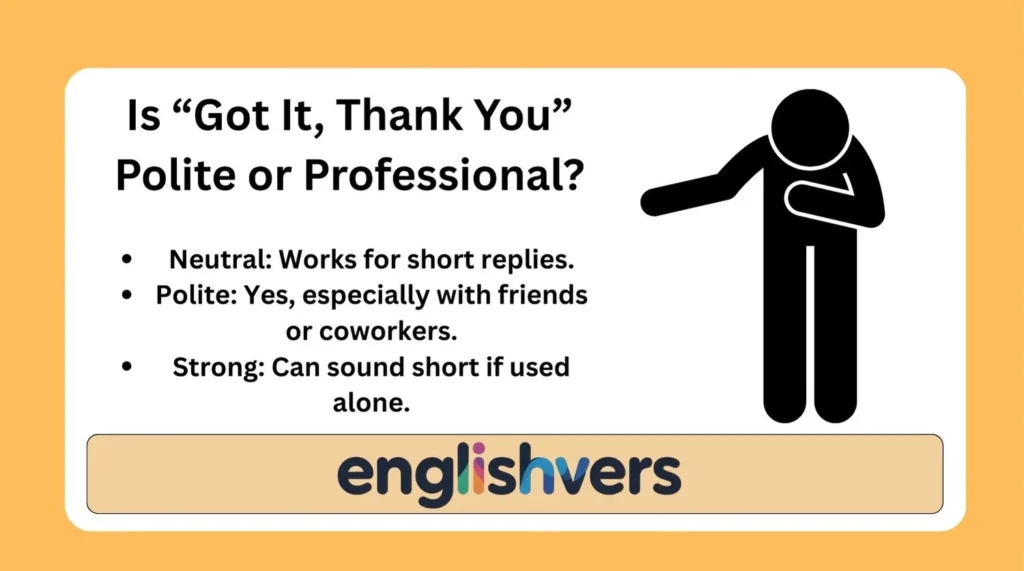
Tone levels depend on context:
- Neutral: Works for short replies.
- Polite: Yes, especially with friends or coworkers.
- Strong: Can sound short if used alone.
- Soft: Add appreciation to sound warmer.
Formal vs Informal
- In formal messages, it may seem too quick or casual.
- In casual conversation, it sounds friendly and efficient.
Etiquette tip:
Avoid using it as your only reply in corporate emails—add a sentence or sign-off.
Pros & Cons of Using “Got It, Thank You”
✔ Pros:
- Short and clear
- Shows understanding
- Sounds friendly
- Easy for all levels of English
✘ Cons:
- Can be too casual
- May appear rushed
- Lacks detail
- Not strong enough for formal communication
Quick Alternatives List (One-Line Phrases)
- Understood, thank you.
- Thanks for the update.
- Noted with thanks.
- I understand now.
- Thanks for letting me know.
- I appreciate the clarification.
- That makes sense, thank you.
- Message received, thank you.
- Gotcha, thanks!
- Appreciate it!
- I’ll take care of it.
- Thanks for explaining.
- All clear now, thank you.
- Copy that.
- Thanks, noted.
Alternatives with Meaning, Usage, and Example Sentences
Understood, thank you.
Meaning: You fully understand what was said.
Explanation: Direct and clear but still polite; commonly used in work communication.
Grammar Note: Past tense verb used as a standalone response.
Example Sentence: Understood, thank you. I’ll handle the report.
Best Use: Workplace; emails; instructions.
Worst Use: Deep emotional conversations.
Tone: Professional, neutral.
Level: Beginner–Intermediate.
Similarity Score: 9/10
Replaceability Tip: Choose when clarity matters more than friendliness.
Thank you for the clarification.
Meaning: You understand because the person explained.
Explanation: Shows appreciation for extra details.
Grammar Note: Noun phrase using “clarification.”
Example Sentence: Thank you for the clarification. That helps a lot.
Best Use: Email; formal conversation.
Worst Use: Quick text messages.
Tone: Polite, formal.
Level: Intermediate.
Similarity Score: 8/10
Replaceability Tip: Use when someone explains something again.
Thanks for the update.
Meaning: You received new information.
Explanation: Friendly but polite; common in business.
Grammar Note: Noun phrase.
Example Sentence: Thanks for the update. Keep me posted.
Best Use: Workplace; online communication.
Worst Use: Serious or emotional topics.
Tone: Friendly, semi-formal.
Level: Beginner.
Similarity Score: 7/10
Replaceability Tip: Use when someone informs you, not when they explain.
Noted with thanks.
Meaning: You noted the information and appreciate it.
Explanation: Very common in Asian business culture.
Grammar Note: Passive form.
Example Sentence: Noted with thanks. I’ll adjust the schedule.
Best Use: Emails; official responses.
Worst Use: Casual chat.
Tone: Professional, concise.
Level: Intermediate.
Similarity Score: 9/10
Replaceability Tip: Use when you want a short, polite record.
I appreciate the information.
Meaning: You value what they shared.
Explanation: Softer, more emotional, more grateful.
Grammar Note: Verb “appreciate.”
Example Sentence: I appreciate the information. It’s very helpful.
Best Use: Professional messages.
Worst Use: Very casual slang chats.
Tone: Warm, polite.
Level: Intermediate.
Similarity Score: 7/10
Replaceability Tip: Good when someone takes time to help.
That makes sense, thank you.
Meaning: You now understand and agree with the logic.
Explanation: Shows understanding AND validation.
Grammar Note: Expression of comprehension.
Example Sentence: That makes sense, thank you for explaining.
Best Use: Learning, tutoring, workplace.
Worst Use: When you still don’t agree.
Tone: Soft, friendly.
Level: Beginner.
Similarity Score: 8/10
Replaceability Tip: Use after someone explains WHY, not what.
All clear, thank you.
Meaning: Everything is understandable.
Explanation: Professional; confirms clarity.
Grammar Note: Adjective phrase.
Example Sentence: All clear, thank you. I’ll send the invoice.
Best Use: Business; meetings.
Worst Use: Emotional topics.
Tone: Efficient, professional.
Level: Intermediate.
Similarity Score: 7/10
Replaceability Tip: Good for final confirmation.
Message received, thank you.
Meaning: You got the message.
Explanation: Written confirmation; common in email trails.
Grammar Note: Past participle.
Example Sentence: Message received, thank you for the details.
Best Use: Email, remote work.
Worst Use: In speech (sounds robotic).
Tone: Formal.
Level: Advanced.
Similarity Score: 8/10
Replaceability Tip: Use when confirming reception digitally.
I’ll take it from here, thanks.
Meaning: You will continue the task.
Explanation: Shows responsibility and initiative.
Grammar Note: Future tense.
Example Sentence: I’ll take it from here, thanks.
Best Use: Workplace teamwork.
Worst Use: When you are not responsible.
Tone: Confident.
Level: Intermediate.
Similarity Score: 6/10
Replaceability Tip: Use when confirming task ownership.
Gotcha, thanks!
Meaning: Informal “I got it.”
Explanation: Friendly, casual, common in the U.S.
Grammar Note: Slang contraction of “got you.”
Example Sentence: Gotcha, thanks! I’ll see you there at 6.
Best Use: Friends; social chat.
Worst Use: Formal emails.
Tone: Casual, playful.
Level: Beginner.
Similarity Score: 7/10
Replaceability Tip: Do NOT use in business or academic writing.
Appreciate it!
Meaning: Short form of “I appreciate it.”
Explanation: Friendly thank-you.
Grammar Note: Truncated phrase.
Example Sentence: Appreciate it! You really helped me.
Best Use: Messages, coworkers you know well.
Worst Use: Formal corporate emails.
Tone: Warm, informal.
Level: Beginner.
Similarity Score: 5/10
Replaceability Tip: Good when you already understand and want gratitude only.
Thank you — I understand now.
Meaning: You understand because of their help.
Explanation: Soft, polite, thoughtful.
Grammar Note: Sentence phrase.
Example Sentence: Thank you — I understand now.
Best Use: Learning, tutoring, feedback.
Worst Use: Quick business replies.
Tone: Respectful.
Level: Beginner–Intermediate.
Similarity Score: 8/10
Replaceability Tip: Use when someone teaches or explains.
Mini Dialogue Examples
Formal
A: Please review this policy before Monday.
B: Thank you for the update. All clear.
Informal
A: Turn left after the coffee shop.
B: Gotcha, thanks!
Business Email Style
Thank you for the clarification. Understood — and I will submit by noon tomorrow.
Mistakes to Avoid
- Saying “Got it” alone — can feel too sharp.
- Using slang in formal writing.
- Repeating the same phrase again and again.
- Saying “Noted” in emotional conversations.
- Copying military expressions like “Copy that” in office emails.
- Using casual replies with new clients.
- Forgetting to add a polite sign-off in email.
Cultural & Tone Tips
- UK English: Tends to sound softer; prefers phrases like “Thanks for the update.”
- US English: Casual expressions like “Gotcha” are more common.
- Casual Social English: Short replies are normal; emojis sometimes replace tone.
Native speakers focus less on perfect words and more on tone and warmth. Polite language builds trust.
Comparison Table — Best Alternatives
| Phrase | Tone | Best Context | Professional Level | Example |
|---|---|---|---|---|
| Understood, thank you | Professional | Workplace instructions | Intermediate | Understood, thank you. |
| Thanks for the update | Friendly | Project updates | Beginner | Thanks for the update. |
| Noted with thanks | Formal | Email record | Intermediate | Noted with thanks. |
| That makes sense, thank you | Soft | Explanation | Beginner | That makes sense, thank you. |
| I appreciate the information | Warm | Tutoring, support | Intermediate | I appreciate the information. |
FAQs
Is “Got it, thank you” rude?
No, but it may sound short if used by itself in formal situations.
Is it okay in emails?
Yes, but better with colleagues you know. For new clients, choose a formal phrase.
What is the most formal alternative?
“Thank you for the clarification.”
What is the simplest beginner alternative?
“Understood, thank you.”
What is the most polite option?
“I appreciate the information.”
Can I use slang versions in work chat?
Use with coworkers you know well—not managers or clients.
Conclusion
Choosing different ways to say “Got it, thank you” improves your clarity, confidence, and communication skills.
Language is powerful. A small change in words can change tone—from friendly to professional to formal.
Learning alternatives helps you write better emails, speak confidently in meetings, and build better relationships through polite, thoughtful language.
Practice these expressions in real conversations to sound more natural, fluent, and respectful in every situation.

Ethan Cole is a passionate language enthusiast dedicated to making English learning simple and enjoyable.