
The word “bro” is widely used in casual conversations, especially among friends. It typically conveys a sense of camaraderie, friendship, or familiarity.
Saying “bro” can make speech feel friendly, relaxed, and informal, but using it in the wrong context—like in business emails or professional meetings—can come across as unprofessional or too casual.
Knowing alternatives to “bro” is essential for English learners and professionals alike. Word choice affects tone, clarity, and how others perceive your communication.
By varying your language, you can sound more polished in business emails, essays, professional meetings, and even social conversations.
For example, saying “Hey, bro, how’s it going?” feels casual and friendly, whereas “Hello, colleague, how are you today?” sounds formal and professional.
Choosing the right alternative ensures your message is clear, appropriate, and context-sensitive.
What Does “Bro” Mean?
Bro is an informal noun used to address a male friend or peer. It is often synonymous with terms like buddy, mate, dude, or pal, depending on regional use. The tone is friendly, casual, and relaxed, but it can seem too informal in professional settings.
- Grammar Form: Noun, slang
- Synonyms: buddy, mate, dude, pal, amigo
- Opposites: colleague, associate, stranger, acquaintance
Sample Sentences:
- Informal: “Hey bro, want to catch a movie tonight?”
- Neutral: “I met my colleague for lunch today.”
When to Use “Bro”
Spoken English
“Bro” is most commonly used in casual conversations with friends or peers. It conveys closeness and familiarity.
Business English
It is not recommended in formal business conversations. Using “bro” with colleagues or clients can seem unprofessional.
Emails / Messages
Avoid using “bro” in corporate emails or professional messages. Stick to alternatives like colleague, team member, or friend depending on context.
Social Media
“Bro” is highly acceptable in casual online posts, comments, and chats, particularly in informal communities or peer groups.
Academic Writing
Using “bro” in essays or research papers is inappropriate. Instead, use peer, classmate, or fellow student.
Professional Meetings
“Bro” is too casual for professional settings. Opt for colleague, team member, or associate instead.
Is “Bro” Polite or Professional?
The tone of “bro” is generally friendly and informal. It can vary depending on who you are addressing:
- Polite: Rarely
- Neutral: Slightly, in informal group contexts
- Strong: Not applicable
- Soft: Friendly and casual
- Formal vs Informal: Informal; not suitable for corporate settings
Etiquette Tip: Use “bro” only with friends or peers in casual settings. Avoid in emails, business conversations, or professional correspondence.
Pros & Cons of Using “Bro”
✔ Pros:
- Builds rapport with friends
- Feels casual and friendly
- Commonly understood among younger speakers
✘ Cons:
- Too informal for professional settings
- Can seem immature in workplace communication
- Not suitable for academic writing
- Can be misunderstood in cross-cultural contexts
Quick Alternatives List
- Buddy
- Mate
- Dude
- Pal
- Friend
- Homie
- Colleague
- Companion
- Amigo
- Broseph
- Partner
- Comrade
- Fellow
- Associate
- Buddy-o
- Chap
Main Alternatives to “Bro”
1. Buddy
Meaning: A close friend or companion.
Explanation: Friendly, casual, slightly more neutral than “bro.”
Grammar Note: Noun, informal
Example Sentence: “Hey buddy, want to grab lunch?”
Best Use: Informal conversations, social media
Worst Use: Formal emails, business meetings
Tone: Friendly
Level: Beginner
Similarity Score: 9
Replaceability Tip: Use when you want a softer casual tone.
2. Mate
Meaning: Friend, peer, or companion.
Explanation: Common in UK/Australian English; neutral but friendly.
Grammar Note: Noun, informal
Example Sentence: “Thanks for helping me, mate.”
Best Use: Social conversations, casual chats
Worst Use: Formal corporate emails
Tone: Friendly
Level: Beginner
Similarity Score: 9
Replaceability Tip: Great in British or Australian English contexts.
3. Dude
Meaning: Casual term for a friend, often used by young speakers.
Explanation: Very informal; emphasizes laid-back tone.
Grammar Note: Noun, slang
Example Sentence: “Dude, that was amazing!”
Best Use: Spoken English, social media
Worst Use: Formal or professional settings
Tone: Friendly, casual
Level: Beginner
Similarity Score: 10
Replaceability Tip: Use with peers in casual contexts.
4. Pal
Meaning: Friend or companion.
Explanation: Slightly old-fashioned but neutral; polite in informal settings.
Grammar Note: Noun, informal
Example Sentence: “You’re a good pal.”
Best Use: Casual conversations, social messages
Worst Use: Professional emails
Tone: Friendly
Level: Beginner
Similarity Score: 9
Replaceability Tip: Ideal for polite casual tone.
5. Homie
Meaning: Close friend, often from your neighborhood or community.
Explanation: Very informal; used in American slang.
Grammar Note: Noun, slang
Example Sentence: “What’s up, homie?”
Best Use: Casual social contexts
Worst Use: Professional emails, meetings
Tone: Friendly, relaxed
Level: Intermediate
Similarity Score: 9
Replaceability Tip: Best among close friends in casual speech.
6. Colleague
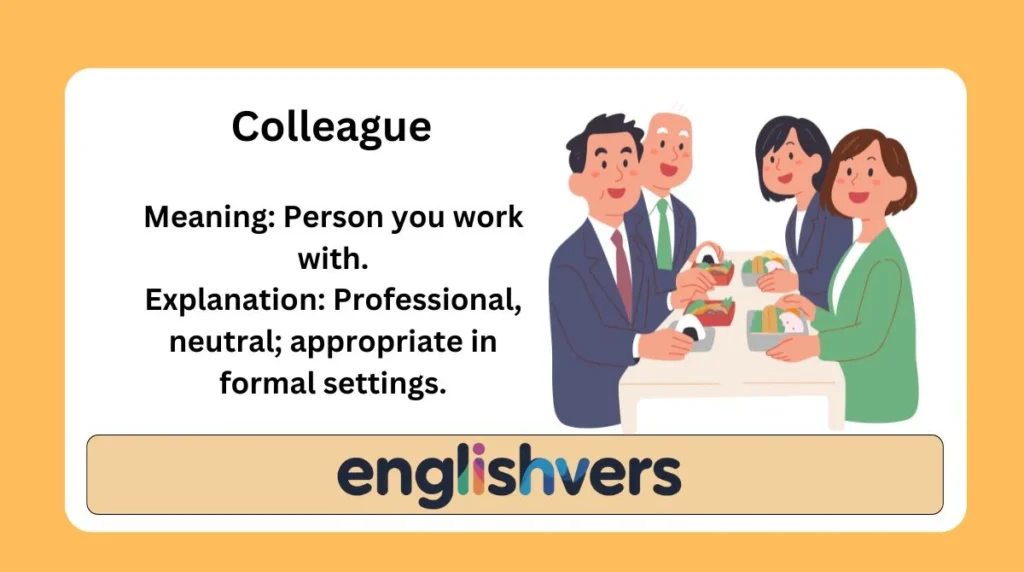
Meaning: Person you work with.
Explanation: Professional, neutral; appropriate in formal settings.
Grammar Note: Noun, formal
Example Sentence: “I discussed the report with my colleague.”
Best Use: Workplace, business emails, professional meetings
Worst Use: Casual chat with friends
Tone: Formal, neutral
Level: Beginner
Similarity Score: 4
Replaceability Tip: Use when professional tone is needed.
7. Companion
Meaning: Someone you spend time with; can be casual or formal.
Explanation: Neutral tone; versatile for different contexts.
Grammar Note: Noun, neutral
Example Sentence: “She was my travel companion.”
Best Use: Academic writing, professional introductions
Worst Use: Very casual text slang
Tone: Neutral, polite
Level: Intermediate
Similarity Score: 6
Replaceability Tip: Use in formal or descriptive settings.
8. Amigo
Meaning: Friend (Spanish origin, used casually).
Explanation: Informal, playful; adds cultural flavor.
Grammar Note: Noun, slang
Example Sentence: “Hola, amigo! How’s it going?”
Best Use: Informal chats, social media
Worst Use: Corporate emails
Tone: Friendly, casual
Level: Beginner
Similarity Score: 8
Replaceability Tip: Fun, casual alternative in informal English.
9. Partner
Meaning: Someone you share a joint activity or business with.
Explanation: Professional or casual, depending on context.
Grammar Note: Noun, formal or neutral
Example Sentence: “My business partner and I signed the contract.”
Best Use: Professional emails, workplace communication
Worst Use: Slangy informal chat
Tone: Professional, neutral
Level: Intermediate
Similarity Score: 5
Replaceability Tip: Use for business or joint ventures.
10. Comrade
Meaning: Companion or colleague, often in shared activities.
Explanation: Formal or political tone; less casual.
Grammar Note: Noun, formal
Example Sentence: “He was a comrade in the project.”
Best Use: Workplace, formal writing
Worst Use: Casual friend chat
Tone: Formal, neutral
Level: Advanced
Similarity Score: 4
Replaceability Tip: Use in formal or historical contexts.
11. Fellow
Meaning: A peer or someone of the same group/status.
Explanation: Neutral, polite; formal for academic/professional use.
Grammar Note: Noun, formal
Example Sentence: “She is a fellow researcher at the institute.”
Best Use: Academic writing, workplace introductions
Worst Use: Casual text
Tone: Formal, neutral
Level: Intermediate
Similarity Score: 5
Replaceability Tip: Use in academic or professional contexts.
12. Chap
Meaning: Informal British term for a man or friend.
Explanation: Friendly, casual, slightly old-fashioned.
Grammar Note: Noun, informal
Example Sentence: “He’s a good chap.”
Best Use: Social, spoken UK English
Worst Use: Corporate email, American English casual chat
Tone: Friendly
Level: Beginner
Similarity Score: 8
Replaceability Tip: Use in UK informal contexts.
Mini Dialogue Examples
Formal Dialogue:
- Person A: “Good morning, colleague. How are you today?”
- Person B: “I’m well, thank you. How about you?”
Informal Dialogue:
- Person A: “Hey bro, ready for the game tonight?”
- Person B: “Absolutely, bro! Can’t wait.”
Business Email Example:
- Subject: Project Update
- Body: “Dear team, I discussed the tasks with my colleague and finalized the timeline. Best regards.”
Mistakes to Avoid
- Using “bro” in emails to your boss or clients.
- Assuming all peers are comfortable with slang terms.
- Overusing casual alternatives in formal contexts.
- Mixing informal tone with professional subjects.
- Misusing culturally specific terms like “mate” or “chap.”
- Using “bro” in academic writing.
- Confusing casual synonyms with formal ones.
Cultural & Tone Tips
- US English: “Bro” and “dude” are widely accepted among younger speakers.
- UK English: “Mate” or “chap” are preferred casual terms.
- Casual Social English: Slang alternatives like “homie” or “amigo” work well.
- Professional Tone: Stick to “colleague, partner, fellow, or associate.”
Comparison Table of Best Alternatives
| Phrase | Tone | Best Context | Professional Level | Example Sentence |
|---|---|---|---|---|
| Buddy | Friendly | Social chats | Low | “Hey buddy, want coffee?” |
| Mate | Friendly | UK casual | Low | “Thanks, mate.” |
| Colleague | Neutral | Workplace | High | “I discussed this with my colleague.” |
| Partner | Neutral | Professional work | High | “My partner finalized the deal.” |
| Fellow | Formal | Academic / Professional | High | “She is a fellow researcher.” |
FAQs
Is “bro” rude?
No, it’s informal but not rude among friends.
Is it okay in emails?
Not recommended in professional emails.
What is the most formal alternative?
Colleague, partner, fellow.
What is the most polite alternative?
Buddy, pal, mate in informal settings; colleague in formal settings.
What should beginners use?
Start with buddy, mate, or colleague depending on context.
Can “bro” be used internationally?
Yes, but cultural perception may vary.
Conclusion
Using alternatives to “bro” improves clarity, professionalism, and tone.
Choosing the right word ensures your communication fits social, business, or academic settings.
By practicing with different expressions, you’ll sound more fluent, natural, and context-appropriate in every conversation.
Varying your vocabulary strengthens both writing and spoken English while helping you avoid awkward or unprofessional situations.

Ethan Cole is a passionate language enthusiast dedicated to making English learning simple and enjoyable.