
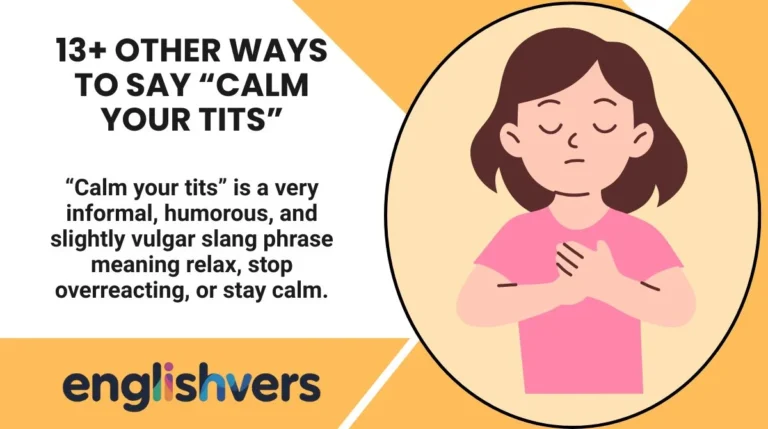
“Calm your tits” is a very informal, humorous, and slightly vulgar slang phrase meaning relax, stop overreacting, or stay calm.
People sometimes use it with friends as a joke, but it can sound rude or disrespectful in the wrong situation.
That’s where alternatives matter. The way we phrase things changes the entire tone of a conversation—especially in global business or professional settings.
Choosing the right words shows emotional intelligence. It affects how people perceive your politeness, confidence, and clarity.
Using varied language also helps you communicate flexibly across emails, meetings, essays, presentations, and social conversations.
Example contrast:
- Informal: “Calm your tits, it’s only a small delay.”
- Formal: “Please stay patient while we resolve the delay.”
What the Phrase Means
The phrase means calm down, remain relaxed, or stop reacting emotionally. It is an idiom used mainly in joking or sarcastic tone. It expresses impatience, shock, or frustration.
Grammar form: Idiom / Imperative expression
Similar phrases: relax, take it easy, chill out
Opposite tone: speak up, react strongly
Sample sentences:
- “Calm your tits, the results come out next week.”
- “He said it as a joke, but it sounded rude.”
When People Use the Phrase
Spoken English
Used between friends jokingly.
Business English
Rare. Risky. Can damage trust and reputation.
Emails / Messages
Almost never acceptable. Tone becomes rude.
Social media
Seen in humorous memes and comments but still sensitive.
Academic writing
Not allowed. Highly informal and vulgar.
Professional meetings
Avoid completely. Use neutral language.
Is the Phrase Polite or Professional?
The phrase is not polite. It is informal, often sarcastic, and mildly vulgar. Some may find it funny; others may find it offensive.
Tone Levels:
Polite – Please stay calm
Neutral – Relax
Strong – Calm your tits
Soft – Let’s take a moment
Formal – Maintain composure
Informal – Chill out
Etiquette Tip
Better avoided in workplace communication. Never use in corporate emails.
Pros & Cons of Using the Phrase
✔ Adds humor when speaking with close friends
✔ Shows confidence and bold personality
✔ Casual and expressive
✘ Can offend easily
✘ Unprofessional in work
✘ Misunderstood by non-native speakers
✘ Sounds disrespectful to older audiences
✘ Not suitable in sensitive conversations
Quick Alternatives List (for fast reference)
- Calm down
- Take it easy
- Relax
- Let’s stay calm
- Keep it cool
- Please be patient
- Don’t stress
- No need to panic
- Maintain composure
- Settle down
- Let’s take a breath
- Don’t worry
- Ease up
- Stay relaxed
- Everything is under control
- Let’s slow things down
Below are 12 detailed alternatives, with meaning, tone, and usage:
“Take it easy”
Meaning: Relax or don’t get upset.
Explanation: Friendly and casual. Good for daily conversation.
Grammar: Informal phrase.
Example: “Take it easy, we still have time.”
Best Use: Texts, casual talk.
Worst Use: Formal emails.
Tone: Friendly
Level: Beginner
Similarity Score: 7/10
Replaceability Tip: Use with friends or peers.
“Relax”
Meaning: Stop being tense.
Explanation: Direct and simple. Can sound blunt if said harshly.
Grammar: Verb
Example: “Relax, things are fine.”
Best Use: Conversations.
Worst Use: When someone is crying.
Tone: Neutral
Level: Beginner
Similarity Score: 6/10
Replaceability Tip: Useful when time is short.
“Please stay calm”
Meaning: Remain calm politely.
Explanation: Shows respect and empathy.
Grammar: Polite request.
Example: “Please stay calm while we check the issue.”
Best Use: Emails, meetings.
Worst Use: Joking with friends.
Tone: Polite professional
Level: Intermediate
Similarity Score: 4/10
Replaceability Tip: Perfect in customer service.
“Let’s remain patient”
Meaning: Wait without frustration.
Explanation: Encourages group calmness.
Grammar: Suggestion.
Example: “Let’s remain patient until we get an update.”
Best Use: Team meetings.
Worst Use: Informal jokes.
Tone: Formal
Level: Intermediate
Similarity Score: 4/10
Replaceability Tip: Best for leadership tone.
“No need to panic”
Meaning: The situation is not serious.
Explanation: Reassuring and gentle.
Grammar: Statement.
Example: “There’s no need to panic, we have backups.”
Best Use: Work, school.
Worst Use: Serious emergencies.
Tone: Soft
Level: Beginner
Similarity Score: 8/10
Replaceability Tip: Good substitute when calming groups.
“Keep it cool”
Meaning: Stay calm and steady.
Explanation: Casual and upbeat.
Grammar: Informal idiom.
Example: “Keep it cool during the interview.”
Best Use: Youth conversation.
Worst Use: Formal writing.
Tone: Friendly
Level: Intermediate
Similarity Score: 7/10
Replaceability Tip: Sounds less harsh than slang.
“Everything is under control”
Meaning: There is a plan.
Explanation: Offers confidence and leadership.
Grammar: Statement.
Example: “Everything is under control, the team is handling it.”
Best Use: Work updates.
Worst Use: Personal arguments.
Tone: Professional
Level: Intermediate
Similarity: 3/10
Replaceability Tip: Great for authority roles.
“Let’s take a moment to breathe”
Meaning: Pause and calm emotions.
Explanation: Soft, caring, mental health friendly.
Grammar: Suggestion.
Example: “Let’s take a moment to breathe before we respond.”
Best Use: Counseling, teaching.
Worst Use: Angry customers.
Tone: Soft
Level: Intermediate
Similarity: 3/10
Replaceability Tip: Best for emotional situations.
“Please be patient”
Meaning: Wait without frustration.
Explanation: Polite and clear.
Grammar: Polite directive.
Example: “Please be patient while the files upload.”
Best Use: Emails, customer support.
Worst Use: Sarcasm.
Tone: Professional
Level: Beginner
Similarity: 4/10
Replaceability Tip: Most universal work phrase.
“I need you to stay calm”
Meaning: Direct request for calm.
Explanation: Serious but respectful.
Grammar: Directive.
Example: “I need you to stay calm so we can solve this.”
Best Use: High-stress moments.
Worst Use: Texting friends as a joke.
Tone: Strong professional
Level: Advanced
Similarity: 6/10
Replaceability Tip: When leadership is required.
“Let’s not jump to conclusions”
Meaning: Don’t react before facts.
Explanation: Focuses on logic, not emotion.
Grammar: Suggestion phrase.
Example: “Let’s not jump to conclusions until we confirm.”
Best Use: Business, reports.
Worst Use: Emotional crises.
Tone: Professional
Level: Advanced
Similarity: 5/10
Replaceability Tip: Very useful in debates.
“Settle down”
Meaning: Calm your emotions.
Explanation: Common, slightly commanding.
Grammar: Phrasal verb.
Example: “Settle down, we will start soon.”
Best Use: Teaching or managing groups.
Worst Use: Angry adults.
Tone: Neutral–Strong
Level: Beginner
Similarity: 8/10
Replaceability Tip: Close to the original but cleaner.
Mini Dialogue Examples
Formal Dialogue
A: “We have not received the results yet!”
B: “I understand your concern. Please stay calm while the lab completes the process.”
Informal Dialogue
A: “Dude, this is stressing me out.”
B: “Take it easy, it’ll work out.”
Business Email Example
Subject: Update on Your Request
Thank you for your patience. Please stay calm while our team finalizes the review. We will update you shortly.
Mistakes to Avoid
- Using slang in professional communication
- Saying “relax” in a rude tone
- Using calming phrases during grief or tragedy
- Overusing emojis with serious messages
- Assuming all cultures find sarcasm funny
- Typing slang in formal emails
- Using strong phrases with customers
Cultural and Tone Tips
US English
The slang version appears in memes but can feel aggressive in serious conversation.
UK English
Sarcasm is common, but vulgarity is not always welcome in formal settings.
Casual Social English
Friends may laugh. Strangers may judge.
Native speakers pay close attention to tone. The same phrase can sound calming or insulting depending on pitch, volume, and context.
Comparison Table
| Phrase | Tone | Best Context | Level | Example |
|---|---|---|---|---|
| Please be patient | Polite | Emails | Beginner | Please be patient while we review. |
| Take it easy | Friendly | Texting | Beginner | Take it easy, bro. |
| Keep it cool | Casual | Friends | Intermediate | Keep it cool during the game. |
| Maintain composure | Formal | Meetings | Advanced | We must maintain composure. |
| No need to panic | Soft | Groups | Beginner | No need to panic, we have time. |
FAQs
Is the original phrase rude?
Yes, it is considered vulgar slang.
Is it okay in emails?
No.
What is the most formal alternative?
Maintain composure.
What is the most polite alternative?
Please stay calm.
What should beginners use?
Relax, Take it easy, or Please be patient.
What should I use at work?
No need to panic / Please stay calm / Let’s take a moment.
Conclusion
The words you choose shape the response you receive. Having different ways to express calmness helps improve clarity, professionalism, and emotional intelligence.
When you use alternatives suited to the situation—formal, informal, or playful—you sound more confident and fluent.
The key is not only vocabulary but tone and respect. Practice these phrases in conversation, emails, and real-life situations.
Over time, choosing the right expression becomes natural.

Ethan Cole is a passionate language enthusiast dedicated to making English learning simple and enjoyable.