
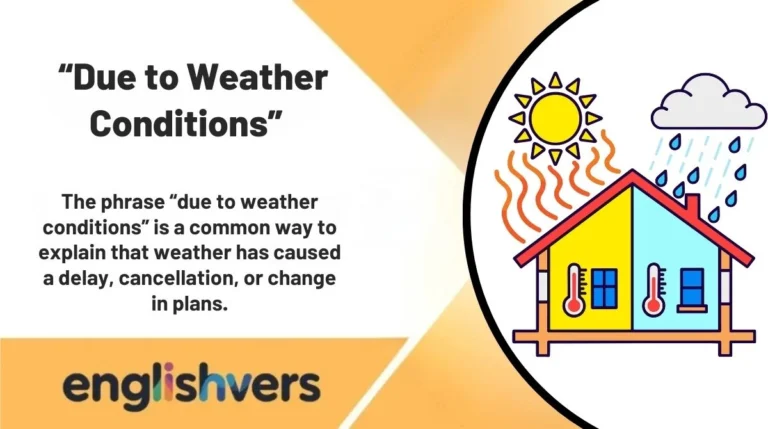
The phrase “due to weather conditions” is a common way to explain that weather has caused a delay, cancellation, or change in plans.
While clear, using the same phrase repeatedly can sound monotonous, especially in emails, reports, or conversations.
Choosing alternatives helps you express the same idea more naturally, showing flexibility in language and improving clarity.
The tone of your words also matters—formal expressions are ideal for professional emails, while informal phrases work better in casual chats.
For example, saying “The event was postponed due to weather conditions” sounds formal, while “The rain messed up our plans” is casual and friendly.
Using varied phrases ensures your English sounds polished, professional, and adaptable across situations.
What Does “Due to Weather Conditions” Mean?
Definition: This phrase explains that weather is the reason behind a particular situation or outcome.
Grammar Form: Prepositional phrase. It connects a cause (weather) with an effect (delay, cancellation, etc.).
Synonyms & Opposites:
- Synonyms: because of the weather, on account of weather, owing to weather, as a result of weather
- Opposites: despite the weather, regardless of the weather
Examples:
- Formal: The flight was canceled due to weather conditions.
- Informal: The match was postponed because of the rain.
When to Use “Due to Weather Conditions”
Spoken English: Use it in clear explanations, such as reporting a delay or giving updates to friends or colleagues.
Business English: Perfect for memos, announcements, and reports where precision and professionalism are key.
Emails / Messages: Suitable for explaining reschedules, delays, or changes in formal emails.
Social Media: Can be adapted informally (e.g., “Our picnic got canceled due to the rain!”)
Academic Writing: Useful for essays or research to attribute cause and effect accurately.
Professional Meetings: Safe to use in presentations, status updates, or client communications.
Is “Due to Weather Conditions” Polite or Professional?
- Polite: ✅ Neutral and factual; doesn’t blame anyone.
- Neutral: ✅ Appropriate in most contexts.
- Strong / Soft: Soft and factual, not commanding.
- Formal vs Informal: Formal in reports, memos, emails; avoid in slangy or casual conversations.
Etiquette Tip: Use it in workplace emails or reports, but choose simpler phrases for chats with friends.
Pros & Cons of Using “Due to Weather Conditions”
✔ Pros:
- Clear and precise explanation
- Professional and factual
- Safe for business, academic, or official communication
✘ Cons:
- Can sound repetitive
- Lacks casual or friendly tone
- Too formal for casual conversations
Quick Alternatives (One-Line Phrases)
- Because of the weather
- On account of weather
- Owing to weather
- As a result of the weather
- Thanks to the weather
- Weather permitting
- Due to rain/snow/wind
- Considering the weather
- In view of the weather conditions
- Caused by weather
- Resulting from the weather
- Attributable to weather
- Weather-related
- Given the weather
- On a rainy/sunny/windy day
15 Alternatives with Full Details
1. Because of the weather
Meaning: Explains that weather caused something.
Explanation: Informal and widely understood; works in daily conversations.
Grammar Note: Prepositional phrase.
Example Sentence: The picnic was canceled because of the weather.
Best Use: Informal chats, social media, spoken English
Worst Use: Highly formal reports
Tone: Friendly / Neutral
Level: Beginner
Similarity Score: 9/10
Replaceability Tip: Use for casual contexts or when simplifying language.
2. Owing to the weather
Meaning: A formal way to indicate weather is the cause.
Explanation: Appropriate in emails, reports, and official announcements.
Grammar Note: Prepositional phrase
Example Sentence: The concert was postponed owing to the weather.
Best Use: Formal writing, business communication
Worst Use: Slang or casual messages
Tone: Formal / Neutral
Level: Intermediate
Similarity Score: 10/10
Replaceability Tip: Ideal for professional correspondence.
3. On account of weather
Meaning: Indicates a reason linked to weather.
Explanation: Slightly old-fashioned but still professional.
Grammar Note: Prepositional phrase
Example Sentence: Flights were delayed on account of the weather.
Best Use: Reports, announcements, formal emails
Worst Use: Casual texting
Tone: Formal / Neutral
Level: Intermediate
Similarity Score: 9/10
Replaceability Tip: Best for formal spoken English or letters.
4. As a result of the weather
Meaning: Shows cause-effect relationship.
Explanation: Works in reports, essays, and presentations.
Grammar Note: Prepositional phrase
Example Sentence: As a result of the weather, the train service was suspended.
Best Use: Academic writing, business reports
Worst Use: Slangy or informal chats
Tone: Formal / Professional
Level: Advanced
Similarity Score: 9/10
Replaceability Tip: Use when linking cause to effect clearly.
5. Weather permitting
Meaning: Suggests an action will happen if weather allows.
Explanation: Softens the statement; implies uncertainty.
Grammar Note: Conditional phrase
Example Sentence: We’ll go hiking tomorrow, weather permitting.
Best Use: Spoken English, invitations
Worst Use: Formal legal or official documents
Tone: Friendly / Neutral
Level: Intermediate
Similarity Score: 7/10
Replaceability Tip: Use when plans depend on the weather.
6. Considering the weather
Meaning: Taking weather into account.
Explanation: Neutral; can introduce reasoning for decisions.
Grammar Note: Gerund phrase
Example Sentence: Considering the weather, we should delay the match.
Best Use: Professional meetings, spoken English
Worst Use: Casual texts (sounds stiff)
Tone: Neutral / Professional
Level: Intermediate
Similarity Score: 8/10
Replaceability Tip: Use when explaining reasoning politely.
7. Caused by weather
Meaning: Explains origin or reason.
Explanation: Simple, factual, suitable for reports or analyses.
Grammar Note: Passive voice phrase
Example Sentence: Flooding was caused by weather.
Best Use: Academic or technical writing
Worst Use: Informal conversation
Tone: Neutral / Formal
Level: Advanced
Similarity Score: 9/10
Replaceability Tip: Good for analytical writing.
8. Resulting from the weather
Meaning: Highlights an outcome due to weather.
Explanation: Professional, academic; emphasizes cause-effect.
Grammar Note: Prepositional phrase
Example Sentence: Flight cancellations resulting from the weather affected thousands.
Best Use: Reports, emails, academic writing
Worst Use: Casual conversation
Tone: Formal / Professional
Level: Advanced
Similarity Score: 9/10
Replaceability Tip: Perfect for formal documentation.
9. Weather-related
Meaning: Describes something linked to weather.
Explanation: Concise; works as an adjective.
Grammar Note: Adjective
Example Sentence: Weather-related delays are common in winter.
Best Use: Reports, headlines, business updates
Worst Use: Casual speech (may sound abrupt)
Tone: Neutral / Professional
Level: Beginner
Similarity Score: 8/10
Replaceability Tip: Use for brevity in written text.
10. Given the weather
Meaning: Taking weather conditions into account.
Explanation: Polite, slightly formal; introduces a decision.
Grammar Note: Prepositional phrase
Example Sentence: Given the weather, we recommend postponing the event.
Best Use: Emails, reports, professional meetings
Worst Use: Casual social chat
Tone: Formal / Polite
Level: Intermediate
Similarity Score: 9/10
Replaceability Tip: Use when justifying decisions professionally.
11. Thanks to the weather
Meaning: Can be used positively or negatively.
Explanation: Casual, often informal; may convey irony.
Grammar Note: Prepositional phrase
Example Sentence: Thanks to the weather, our outdoor party got rained out.
Best Use: Informal conversation, social media
Worst Use: Professional emails (sounds sarcastic)
Tone: Informal / Neutral
Level: Beginner
Similarity Score: 7/10
Replaceability Tip: Best for casual speech.
12. In view of the weather conditions
Meaning: Taking the weather into consideration.
Explanation: Formal; good for announcements or updates.
Grammar Note: Prepositional phrase
Example Sentence: In view of the weather conditions, the festival has been rescheduled.
Best Use: Professional emails, official announcements
Worst Use: Casual chats
Tone: Formal / Professional
Level: Advanced
Similarity Score: 9/10
Replaceability Tip: Use in official notifications.
13. Attributable to weather
Meaning: Identifies weather as the reason.
Explanation: Formal, technical; common in reports and research.
Grammar Note: Passive participle phrase
Example Sentence: The flight delays were largely attributable to weather.
Best Use: Reports, technical writing
Worst Use: Spoken English
Tone: Formal / Professional
Level: Advanced
Similarity Score: 10/10
Replaceability Tip: Use in research or analytical writing.
14. Due to rain/snow/wind
Meaning: Specifies the type of weather causing the issue.
Explanation: More precise than “weather conditions”; casual or formal depending on context.
Grammar Note: Prepositional phrase
Example Sentence: The match was canceled due to heavy rain.
Best Use: Emails, announcements, casual updates
Worst Use: Unspecified weather contexts
Tone: Neutral / Professional
Level: Beginner
Similarity Score: 10/10
Replaceability Tip: Use when specifying exact weather.
15. Regardless of the weather
Meaning: Emphasizes that something happens no matter the weather.
Explanation: Shows determination or commitment; opposite of “due to weather conditions.”
Grammar Note: Prepositional phrase
Example Sentence: The parade will proceed regardless of the weather.
Best Use: Speeches, motivational statements
Worst Use: When giving reasons for delay
Tone: Strong / Formal
Level: Intermediate
Similarity Score: 4/10
Replaceability Tip: Use to stress continuity despite weather.
Mini Dialogue Examples
Formal Dialogue:
- Manager: “The outdoor meeting has been postponed due to weather conditions.”
- Employee: “Understood. Shall we reschedule for next week?”
Informal Dialogue:
- Friend 1: “Can we go hiking tomorrow?”
- Friend 2: “I don’t think so, because of the rain.”
Business Email Example:
Subject: Event Postponement
Dear Team,
The client meeting scheduled for tomorrow has been delayed owing to weather conditions. A revised schedule will follow shortly.
Best regards,
Sarah
Mistakes to Avoid
- Using the phrase too often in one text
- Mixing formal phrases in casual chats (sounds stiff)
- Overcomplicating with uncommon synonyms (confuses readers)
- Omitting context (leaves audience guessing)
- Misplacing commas in formal writing
- Using sarcastic tones in professional emails
- Forgetting to specify type of weather when necessary
Cultural & Tone Tips
- UK English: “Owing to the weather” or “due to weather conditions” is common in formal writing.
- US English: “Because of the weather” or “due to weather conditions” is preferred; more casual options like “thanks to the rain” work in speech.
- Casual social English: Native speakers often simplify to “because it’s raining” or “rain messed things up.”
Comparison Table
| Phrase | Tone | Best Context | Professional Level | Example |
|---|---|---|---|---|
| Due to weather conditions | Neutral | Formal emails, reports | High | The flight was canceled due to weather conditions. |
| Because of the weather | Friendly | Casual speech | Low | The picnic got canceled because of the weather. |
| Owing to the weather | Formal | Reports, announcements | High | Owing to the weather, the festival is postponed. |
| Weather permitting | Neutral | Spoken English, invitations | Medium | We’ll hike tomorrow, weather permitting. |
| In view of the weather conditions | Formal | Official updates | High | In view of the weather conditions, the event is rescheduled. |
FAQs
Is “due to weather conditions” rude?
No, it is neutral and polite.
Is it okay in emails?
Yes, it is safe and professional.
What is the most formal alternative?
“In view of the weather conditions.”
What is the most polite alternative?
“Considering the weather.”
What should beginners use?
“Because of the weather” or “due to weather conditions.”
Can it be used in casual conversation?
Yes, but simpler phrases like “because of the rain” sound more natural.
Conclusion
Using alternatives to “due to weather conditions” enhances clarity, variety, and tone in English. Professionals benefit from formal expressions, while learners improve natural communication with casual options. Practicing these alternatives in emails, conversations, and social media ensures fluency and makes your English sound polished and adaptable. Varying your word choice not only prevents repetition but also conveys precise meaning in every context.

Ethan Cole is a passionate language enthusiast dedicated to making English learning simple and enjoyable.