
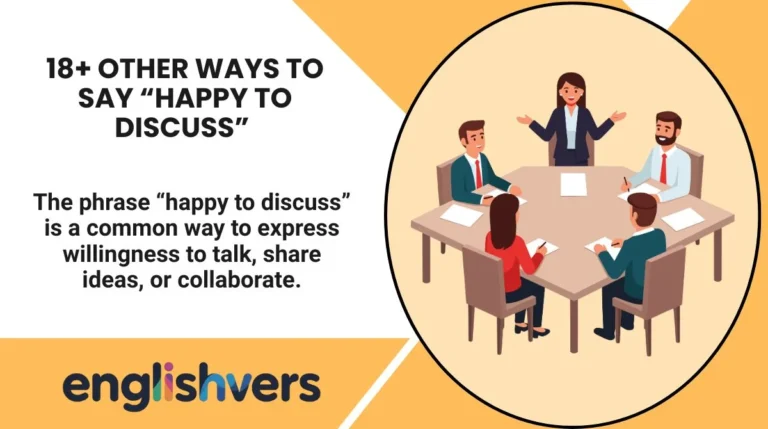
The phrase “happy to discuss” is a common way to express willingness to talk, share ideas, or collaborate.
It signals openness, cooperation, and a positive attitude in both personal and professional contexts.
Using this phrase appropriately helps speakers and writers convey friendliness, professionalism, and approachability.
However, relying on the same phrase repeatedly can make your communication feel repetitive or robotic.
Exploring alternatives allows you to adjust tone, formality, and emotional nuance according to your audience.
For example, in a formal business email, you might write, “I would be pleased to discuss this further.”
In contrast, in a casual chat with a friend, you might simply say, “Sure, let’s talk about it!” Choosing the right words ensures your communication is clear, professional, and engaging.
By learning varied expressions, English learners, professionals, and writers can strengthen their vocabulary, avoid monotony, and communicate more confidently in emails, meetings, essays, and casual conversations.
What Does “Happy to Discuss” Mean?
Definition:
“Happy to discuss” expresses willingness or readiness to engage in a conversation, answer questions, or provide input. It is polite and conveys a positive attitude.
Grammar Form:
It is a phrase used as a polite statement. The verb “happy” acts as an adjective, and “to discuss” is an infinitive verb.
Synonyms:
- Glad to talk
- Pleased to chat
- Willing to review
- Open to discuss
Opposite Tones:
- Reluctant to discuss
- Not interested in discussing
Sample Sentences:
- I’m happy to discuss your proposal at your convenience.
- She said she was happy to discuss the project ideas during the meeting.
When to Use “Happy to Discuss”
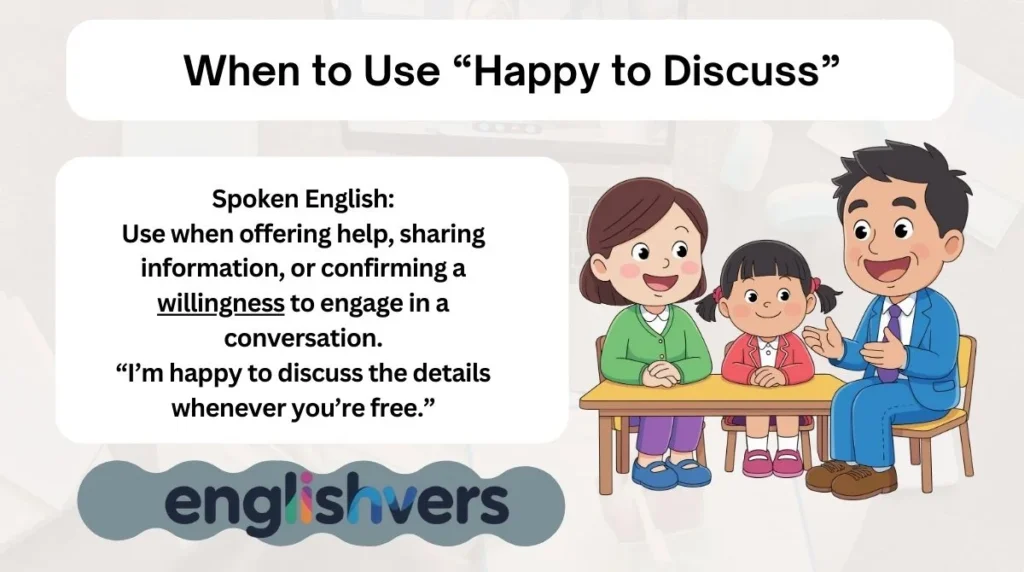
Spoken English:
Use when offering help, sharing information, or confirming a willingness to engage in a conversation.
- “I’m happy to discuss the details whenever you’re free.”
Business English:
Common in professional meetings, project discussions, or collaborations. Signals approachability and cooperation.
Emails / Messages:
Perfect for responding politely to inquiries. It sets a positive tone and shows readiness.
- “I’m happy to discuss this further via email or a call.”
Social Media:
Works in private messages or comments where you want to appear friendly and cooperative.
Academic Writing:
Less common in formal essays but useful in cover letters, recommendation letters, or collaborative projects.
Professional Meetings:
Signals openness and encourages dialogue without imposing pressure.
Is “Happy to Discuss” Polite or Professional?
Tone Levels:
- Polite: Yes, it’s naturally courteous.
- Neutral: Suitable for general communication.
- Strong: Not forceful or assertive.
- Soft: Conveys warmth and cooperation.
Formal vs Informal:
- Formal: “I would be pleased to discuss this further.”
- Informal: “Sure, happy to chat about it!”
Etiquette Tip:
Better for workplace emails, meetings, and professional interactions. Avoid overusing in casual conversations, as it can sound stiff or scripted.
Pros & Cons of Using “Happy to Discuss”
✔ Pros:
- Polite and approachable
- Easy to understand
- Suitable in both spoken and written contexts
- Signals cooperation
✘ Cons:
- Can sound repetitive if overused
- May seem overly formal in casual settings
- Lacks emotional nuance compared to alternatives
Quick Alternatives List (One-Line Phrases Only)
- Glad to chat
- Pleased to discuss
- Open to discussion
- Available to talk
- Let’s go over it
- I’d be delighted to discuss
- Happy to review
- Ready to talk
- I’d love to go over this
- Let’s discuss this further
- Open for a conversation
- Happy to provide input
- Ready when you are
- Eager to discuss
- Willing to discuss
- I’m here to talk
- Available for discussion
15 Alternatives to “Happy to Discuss”
1. Glad to Chat
Meaning: Willing and pleased to talk informally.
Explanation: Friendly, approachable tone for casual conversations.
Grammar Note: Informal phrase
Example Sentence: I’m glad to chat whenever you have time.
Best Use: Informal, text, social media
Worst Use: Formal emails
Tone: Friendly
Level: Beginner
Similarity Score: 8/10
Replaceability Tip: Use for casual or semi-professional discussions.
2. Pleased to Discuss
Meaning: Formal expression of willingness to talk.
Explanation: Conveys politeness and professionalism.
Grammar Note: Formal phrase
Example Sentence: I’d be pleased to discuss your proposal in detail.
Best Use: Emails, meetings, official communication
Worst Use: Text messages
Tone: Formal
Level: Intermediate
Similarity Score: 10/10
Replaceability Tip: Ideal in corporate or academic contexts.
3. Open to Discussion
Meaning: Ready to consider ideas or feedback.
Explanation: Neutral, collaborative tone, common in professional and academic settings.
Grammar Note: Adjective + noun phrase
Example Sentence: I’m open to discussion on this topic.
Best Use: Business meetings, group projects
Worst Use: Casual texting
Tone: Neutral
Level: Intermediate
Similarity Score: 9/10
Replaceability Tip: Use when you want to signal flexibility.
4. Available to Talk
Meaning: Ready and free to have a conversation.
Explanation: Practical, direct alternative with neutral tone.
Grammar Note: Adjective + infinitive
Example Sentence: I’m available to talk this afternoon.
Best Use: Professional calls, scheduling meetings
Worst Use: Informal chats with friends
Tone: Neutral / Professional
Level: Beginner
Similarity Score: 8/10
Replaceability Tip: Use when scheduling or confirming availability.
5. Let’s Go Over It
Meaning: Suggest reviewing or discussing something together.
Explanation: Collaborative and informal; slightly casual but clear.
Grammar Note: Imperative verb phrase
Example Sentence: Let’s go over your notes before the presentation.
Best Use: Workplace, study sessions
Worst Use: Formal corporate emails
Tone: Friendly
Level: Intermediate
Similarity Score: 7/10
Replaceability Tip: Best in teamwork or study contexts.
6. I’d Be Delighted to Discuss
Meaning: Very polite, formal way to offer conversation.
Explanation: Expresses enthusiasm professionally.
Grammar Note: Conditional + infinitive
Example Sentence: I’d be delighted to discuss the report in detail.
Best Use: Business emails, professional meetings
Worst Use: Casual chats
Tone: Formal / Polite
Level: Advanced
Similarity Score: 10/10
Replaceability Tip: Use to impress in professional or academic communication.
7. Happy to Review
Meaning: Willing to look over something and provide feedback.
Explanation: Professional, action-oriented phrase.
Grammar Note: Adjective + infinitive
Example Sentence: I’m happy to review the draft before submission.
Best Use: Workplace, academic feedback
Worst Use: Social media
Tone: Neutral / Professional
Level: Intermediate
Similarity Score: 9/10
Replaceability Tip: Use when reviewing documents, plans, or projects.
8. Ready to Talk
Meaning: Prepared and willing to engage in conversation.
Explanation: Direct and clear; neutral tone for most contexts.
Grammar Note: Adjective + infinitive
Example Sentence: I’m ready to talk whenever you are.
Best Use: Meetings, calls, quick chats
Worst Use: Highly formal letters
Tone: Neutral / Friendly
Level: Beginner
Similarity Score: 8/10
Replaceability Tip: Use when emphasizing readiness and availability.
9. I’d Love to Go Over This
Meaning: Expresses enthusiasm for discussing a topic.
Explanation: Friendly and positive tone; slightly informal.
Grammar Note: Conditional + infinitive
Example Sentence: I’d love to go over this plan with you.
Best Use: Team meetings, informal emails
Worst Use: Formal academic writing
Tone: Friendly
Level: Intermediate
Similarity Score: 8/10
Replaceability Tip: Shows genuine interest without being too formal.
10. Open for a Conversation
Meaning: Willing to engage in discussion.
Explanation: Neutral, versatile phrase suitable in multiple contexts.
Grammar Note: Adjective + prepositional phrase
Example Sentence: I’m open for a conversation anytime this week.
Best Use: Workplace, emails, meetings
Worst Use: Casual texting
Tone: Neutral / Professional
Level: Intermediate
Similarity Score: 9/10
Replaceability Tip: Use for approachable yet professional tone.
11. Happy to Provide Input
Meaning: Willing to offer suggestions or advice.
Explanation: Professional and helpful; conveys contribution to discussion.
Grammar Note: Adjective + infinitive
Example Sentence: I’m happy to provide input on the marketing strategy.
Best Use: Work meetings, professional emails
Worst Use: Casual conversation
Tone: Professional
Level: Intermediate
Similarity Score: 10/10
Replaceability Tip: Perfect for collaborative work.
12. Ready When You Are
Meaning: Indicates immediate availability.
Explanation: Casual and friendly; shows patience and readiness.
Grammar Note: Fixed phrase
Example Sentence: I’m ready when you are to discuss the project.
Best Use: Informal meetings, calls
Worst Use: Formal writing
Tone: Friendly
Level: Beginner
Similarity Score: 7/10
Replaceability Tip: Great for flexible, informal timing.
13. Eager to Discuss
Meaning: Enthusiastic about engaging in conversation.
Explanation: Conveys positive energy; slightly more emotional.
Grammar Note: Adjective + infinitive
Example Sentence: I’m eager to discuss your ideas during the session.
Best Use: Team meetings, presentations
Worst Use: Casual texting
Tone: Professional / Friendly
Level: Intermediate
Similarity Score: 9/10
Replaceability Tip: Use when you want to express strong interest politely.
14. Willing to Discuss
Meaning: Neutral, formal expression of availability.
Explanation: Emphasizes readiness and consent to talk.
Grammar Note: Adjective + infinitive
Example Sentence: I am willing to discuss these changes further.
Best Use: Business emails, formal meetings
Worst Use: Informal chats
Tone: Neutral / Professional
Level: Intermediate
Similarity Score: 9/10
Replaceability Tip: Use in formal or legal contexts.
15. I’m Here to Talk
Meaning: Informal, approachable way to offer conversation.
Explanation: Friendly, supportive tone; more personal.
Grammar Note: Subject + verb + infinitive
Example Sentence: I’m here to talk if you want to discuss anything.
Best Use: Casual conversations, social support
Worst Use: Professional reports or academic writing
Tone: Friendly / Soft
Level: Beginner
Similarity Score: 7/10
Replaceability Tip: Great for emotional support or informal discussion.
Mini Dialogue Examples
Formal Dialogue:
- A: Could we discuss the quarterly results?
- B: I’d be pleased to discuss this in the meeting tomorrow.
Informal Dialogue:
- A: Hey, want to go over the project notes?
- B: Sure, I’m happy to chat!
Business Email:
- Dear Mr. Smith, I’m happy to discuss your proposal at a time convenient for you. Please let me know your availability.
Mistakes to Avoid
- Using “happy to discuss” in overly casual settings with strangers.
- Overusing the phrase, making emails repetitive.
- Mixing formal alternatives in informal texts.
- Using vague alternatives that sound passive or unhelpful.
- Confusing tone—e.g., using “delighted” in a casual chat.
- Forgetting subject-verb agreement in alternative phrases.
- Overloading sentences with multiple alternatives at once.
Cultural & Tone Tips
- UK English: Polite and professional; often slightly understated.
- US English: Friendly and approachable; may use more enthusiastic alternatives.
- Casual Social English: Short, relaxed phrases like “glad to chat” or “ready when you are” feel natural.
Comparison Table of Top Alternatives
| Phrase | Tone | Best Context | Professional Level | Example |
|---|---|---|---|---|
| Pleased to Discuss | Formal | Emails, Meetings | High | I’d be pleased to discuss your proposal. |
| Glad to Chat | Friendly | Social, Informal | Low | I’m glad to chat whenever you like. |
| Open to Discussion | Neutral | Academic, Workplace | Medium | I’m open to discussion on this issue. |
| I’d Be Delighted to Discuss | Polite | Corporate | High | I’d be delighted to discuss this further. |
| Happy to Provide Input | Professional | Workplace | Medium | I’m happy to provide input on your draft. |
FAQs
Is “happy to discuss” rude?
No, it’s polite and professional.
Is it okay in emails?
Yes, widely used in professional correspondence.
What is the most formal alternative?
“I’d be delighted to discuss” is highly formal.
What is the most polite alternative?
“Pleased to discuss” conveys politeness and professionalism.
What should beginners use?
“Glad to chat” or “happy to discuss” is simple and natural.
Can it be used in casual texting?
Yes, but shorter phrases like “glad to chat” or “ready when you are” sound more natural.
Conclusion
Using alternatives to “happy to discuss” allows English learners and professionals to convey willingness with clarity and nuance.
The right phrase can make conversations more engaging, emails more professional, and interactions friendlier.
By practicing these alternatives, you can communicate more confidently, adapt to different tones, and avoid repetitive expressions.
Experimenting with formal, neutral, and informal phrases ensures that your message always fits the context, whether in meetings, emails, essays, or daily chats.

Ethan Cole is a passionate language enthusiast dedicated to making English learning simple and enjoyable.