
The phrase “I appreciate you” is one of the simplest yet most powerful ways to express gratitude.
At its core, it communicates recognition, respect, and value for someone’s actions, support, or presence.
While widely used, relying solely on this phrase can make conversations, emails, or essays feel repetitive.
Exploring alternatives allows speakers and writers to convey the same sentiment with nuance, professionalism, or casual warmth depending on the context.
Choosing the right words affects not only tone but also clarity and audience perception. For example, saying “I truly appreciate your efforts” in a business email sounds formal and professional,
while telling a friend “Thanks a ton!” feels casual and friendly. Using varied language can elevate communication in emails,
workplace meetings, social media, and daily conversation, making your gratitude more impactful and memorable.
What Does “I Appreciate You” Mean?
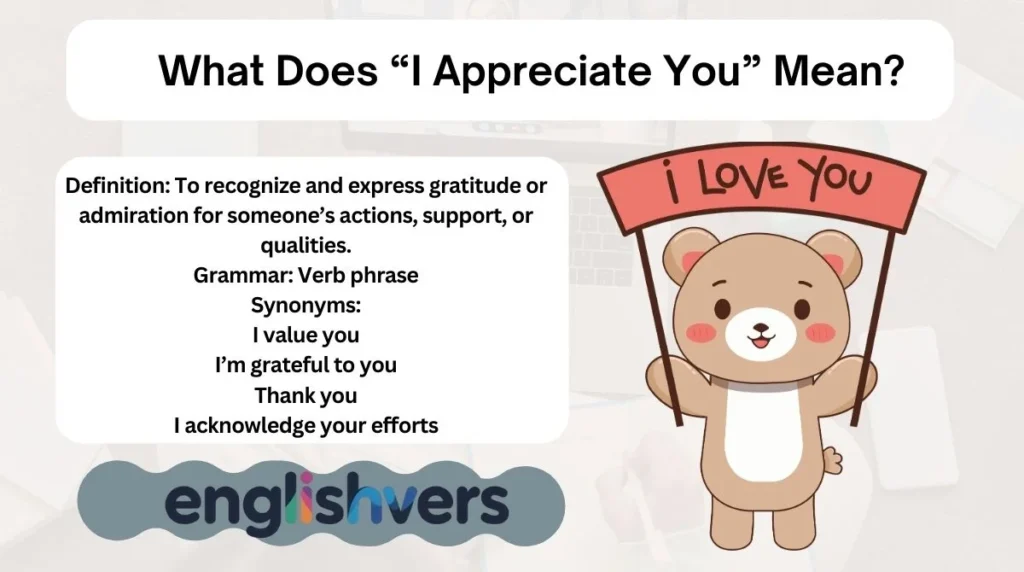
Definition: To recognize and express gratitude or admiration for someone’s actions, support, or qualities.
Grammar: Verb phrase
Synonyms:
- I value you
- I’m grateful to you
- Thank you
- I acknowledge your efforts
Opposites:
- I ignore you
- I take you for granted
Example Sentences:
- I appreciate you taking the time to review my report.
- She really appreciates you helping her move last weekend.
When to Use “I Appreciate You”
Spoken English
Use it in personal conversations to express genuine gratitude:
- “I appreciate you always being there for me.”
Business English
Perfect for professional recognition and acknowledgment:
- “I appreciate you completing this project ahead of schedule.”
Emails / Messages
Shows politeness and professionalism in written communication:
- “I appreciate your prompt response to my inquiry.”
Social Media
Works as a friendly acknowledgment in posts or comments:
- “I appreciate all your support on my recent video!”
Academic Writing
Generally less common, but suitable in acknowledgments:
- “I appreciate the guidance provided by my mentor throughout this research.”
Professional Meetings
Shows respect and acknowledgment during team discussions:
- “I appreciate your insights on the marketing strategy today.”
Is “I Appreciate You” Polite or Professional?
Tone Levels:
- Polite: ✔ Yes, universally polite
- Neutral: ✔ Suitable for general use
- Strong: ❌ Not typically used for strong emotional impact
- Soft: ✔ Gentle, warm
Formal vs Informal:
- Formal: “I appreciate your time and effort.”
- Informal: “Hey, I really appreciate you!”
Etiquette Tip:
Better for workplace, emails, and casual conversations. Avoid overusing in corporate reports where a neutral “Thank you” or specific acknowledgment may sound more precise.
Pros & Cons of Using “I Appreciate You”
✔ Pros:
- Simple and clear
- Universally understood
- Can be adapted for formal or informal settings
✘ Cons:
- Overused in professional contexts
- Can feel generic if repeated
- May lack emotional depth in casual relationships
Quick Alternatives (One-Line Phrases)
- I value your support
- I’m grateful to you
- Thank you for your efforts
- Much obliged
- I respect your work
- Thanks a lot
- I owe you one
- Hats off to you
- I acknowledge your help
- Many thanks
- Cheers
- I’m indebted to you
- Kudos to you
- I recognize your contribution
- Heartfelt thanks
15 Alternatives to “I Appreciate You”
1. I Value Your Efforts
Meaning: Acknowledges someone’s contribution or work.
Explanation: Highlights the importance of the person’s actions in a professional or personal context.
Grammar Note: Verb phrase, formal
Example Sentence: I value your efforts in completing this report ahead of time.
Best Use: Workplace, Email, Professional
Worst Use: Informal text to close friends
Tone: Formal, Respectful
Level: Intermediate
Similarity Score: 9/10
Replaceability Tip: Use when emphasizing contribution rather than just gratitude.
2. I’m Grateful to You
Meaning: Expresses genuine thanks and personal recognition.
Explanation: Slightly more personal than “I appreciate you,” conveys emotional depth.
Grammar Note: Verb phrase, polite
Example Sentence: I’m grateful to you for helping me prepare for the presentation.
Best Use: Emails, Spoken, Professional
Worst Use: Very casual slang conversations
Tone: Friendly, Polite
Level: Beginner
Similarity Score: 8/10
Replaceability Tip: Best for showing sincere gratitude in formal and semi-formal contexts.
3. Thank You for Your Support
Meaning: General acknowledgment of help or assistance.
Explanation: Safe, clear, and widely accepted.
Grammar Note: Phrase, neutral
Example Sentence: Thank you for your support during the fundraising campaign.
Best Use: Emails, Social media, Meetings
Worst Use: Text slang (sounds too formal)
Tone: Neutral, Polite
Level: Beginner
Similarity Score: 7/10
Replaceability Tip: Good for official contexts or when specific contributions are noted.
4. Much Obliged
Meaning: Formal way to express gratitude.
Explanation: Slightly old-fashioned; often used in professional or literary contexts.
Grammar Note: Idiom
Example Sentence: I’m much obliged for your assistance in this matter.
Best Use: Business letters, Formal communication
Worst Use: Casual chat or social media
Tone: Formal
Level: Advanced
Similarity Score: 7/10
Replaceability Tip: Use in formal writing or polite conversation with senior professionals.
5. I Respect Your Work
Meaning: Acknowledges skill or effort in a professional way.
Explanation: Focuses on recognition rather than gratitude alone.
Grammar Note: Verb phrase
Example Sentence: I respect your work on this project; it sets a high standard.
Best Use: Workplace, Emails, Professional
Worst Use: Casual friend conversation
Tone: Professional, Formal
Level: Intermediate
Similarity Score: 8/10
Replaceability Tip: When you want to combine praise with acknowledgment.
6. Thanks a Lot
Meaning: Casual expression of gratitude.
Explanation: Friendly, informal, widely used in daily life.
Grammar Note: Idiomatic phrase
Example Sentence: Thanks a lot for picking me up yesterday.
Best Use: Informal, Social media, Texts
Worst Use: Formal business emails
Tone: Friendly, Casual
Level: Beginner
Similarity Score: 6/10
Replaceability Tip: Best for close friends and informal settings.
7. I Owe You One
Meaning: Indicates a favor is recognized and will be returned.
Explanation: Informal, often playful or friendly.
Grammar Note: Idiom
Example Sentence: Thanks for helping me move—I owe you one!
Best Use: Friends, Casual email
Worst Use: Formal letters or corporate settings
Tone: Casual, Friendly
Level: Intermediate
Similarity Score: 6/10
Replaceability Tip: Use for personal favors, not professional acknowledgment.
8. Hats Off to You
Meaning: Expresses admiration or respect.
Explanation: Informal and figurative; shows high regard.
Grammar Note: Idiom
Example Sentence: Hats off to you for finishing the marathon!
Best Use: Informal, Social media
Worst Use: Professional emails
Tone: Friendly, Complimentary
Level: Intermediate
Similarity Score: 5/10
Replaceability Tip: Use to celebrate achievement rather than express simple thanks.
9. I Acknowledge Your Help
Meaning: Formal recognition of assistance.
Explanation: Useful in professional contexts where appreciation needs clarity.
Grammar Note: Verb phrase, formal
Example Sentence: I acknowledge your help in drafting the client report.
Best Use: Workplace, Email, Academic
Worst Use: Casual conversation
Tone: Formal, Professional
Level: Advanced
Similarity Score: 8/10
Replaceability Tip: Best for official acknowledgment rather than personal gratitude.
10. Many Thanks
Meaning: Simple, polite gratitude.
Explanation: Neutral and concise; widely used in emails and letters.
Grammar Note: Phrase, polite
Example Sentence: Many thanks for your timely response.
Best Use: Emails, Letters
Worst Use: Informal texts or spoken chat
Tone: Polite, Neutral
Level: Beginner
Similarity Score: 7/10
Replaceability Tip: Quick alternative for email closings.
11. Cheers
Meaning: Informal thanks, often in UK English.
Explanation: Friendly, casual; context-dependent.
Grammar Note: Interjection
Example Sentence: Cheers for helping me with my homework!
Best Use: Informal, Social, UK context
Worst Use: Formal business emails
Tone: Friendly, Casual
Level: Beginner
Similarity Score: 5/10
Replaceability Tip: Best with friends or colleagues in casual conversations.
12. I’m Indebted to You
Meaning: Expresses deep gratitude or recognition of favor.
Explanation: Formal, slightly serious, conveys emotional weight.
Grammar Note: Verb phrase, formal
Example Sentence: I’m indebted to you for your mentorship during my internship.
Best Use: Professional letters, Formal emails
Worst Use: Casual text
Tone: Formal, Respectful
Level: Advanced
Similarity Score: 8/10
Replaceability Tip: Use to express sincere, lasting gratitude.
13. Kudos to You
Meaning: Compliment expressing respect or admiration.
Explanation: Informal, energetic, often used in social media or casual contexts.
Grammar Note: Interjection/Slang
Example Sentence: Kudos to you for winning the award!
Best Use: Social media, Informal emails
Worst Use: Formal workplace emails
Tone: Friendly, Enthusiastic
Level: Intermediate
Similarity Score: 6/10
Replaceability Tip: Use for celebratory acknowledgment, not formal thanks.
14. I Recognize Your Contribution
Meaning: Formal acknowledgment of effort or achievement.
Explanation: Professional and precise; suitable for workplace or academic recognition.
Grammar Note: Verb phrase, formal
Example Sentence: I recognize your contribution to the annual report.
Best Use: Workplace, Email, Academic
Worst Use: Casual conversation
Tone: Formal, Professional
Level: Advanced
Similarity Score: 9/10
Replaceability Tip: Use in meetings or emails where formal acknowledgment is needed.
15. Heartfelt Thanks
Meaning: Expresses sincere, emotional gratitude.
Explanation: Warm, personal, and deeply appreciative.
Grammar Note: Phrase, emotional
Example Sentence: Heartfelt thanks for all your support during this project.
Best Use: Personal notes, Email, Letters
Worst Use: Casual workplace chat
Tone: Friendly, Sincere
Level: Intermediate
Similarity Score: 8/10
Replaceability Tip: Use when emotional connection is important.
Mini Dialogue Examples
Formal Dialogue:
- A: “I appreciate your assistance on the client presentation.”
- B: “It’s my pleasure. Happy to help.”
Informal Dialogue:
- A: “Thanks a ton for picking me up!”
- B: “No problem, anytime!”
Business Email Example:
Subject: Thank You
Dear Sarah,
I appreciate your prompt support in finalizing the report. Your insights were invaluable.
Best regards, John
Mistakes to Avoid
- Overusing “I appreciate you” in every sentence
- Using overly casual alternatives in formal emails
- Forgetting to acknowledge specific actions or efforts
- Mixing slang with formal contexts (e.g., “Cheers” in a corporate email)
- Using vague phrases without context
- Confusing tone with exaggeration (e.g., “I’m indebted to you” for minor favors)
Cultural & Tone Tips
- UK English: “Cheers” is casual, friendly; “Much obliged” is formal and polite
- US English: “Thanks a lot” or “I appreciate your help” are common
- Casual social English: Friendly alternatives like “Kudos” or “Hats off” work well
- Native speakers perceive variation as more engaging and thoughtful than repetition
Comparison Table of Top Alternatives
| Phrase | Tone | Best Context | Professional Level | Example |
|---|---|---|---|---|
| I Value Your Efforts | Formal | Workplace, Email | High | I value your efforts in completing this project. |
| I’m Grateful to You | Friendly | Emails, Spoken | Medium | I’m grateful to you for helping with the report. |
| Thank You for Your Support | Neutral | Email, Social | High | Thank you for your support on this project. |
| Much Obliged | Formal | Letters, Workplace | High | I’m much obliged for your guidance. |
| Kudos to You | Casual | Social media, Informal | Low | Kudos to you for winning the contest! |
| Heartfelt Thanks | Sincere | Personal, Email | Medium | Heartfelt thanks for all your support. |
FAQs
Is “I appreciate you” rude?
No, it is always polite and respectful.
Is it okay in emails?
Yes, particularly in professional or semi-formal emails.
What is the most formal alternative?
“Much obliged” or “I recognize your contribution.”
What is the most polite alternative?
“I’m grateful to you” or “I value your efforts.”
What should beginners use?
“Thank you for your support” is simple and widely understood.
Can I use it with friends?
Absolutely, informal variations like “Thanks a ton” or “Kudos” work best.
Conclusion
Using alternatives to “I appreciate you” improves clarity, professionalism, and emotional impact.
Varied expressions allow you to match tone with context, from formal workplace emails to casual conversations with friends.
By practicing these phrases, you can communicate gratitude more effectively, making your interactions richer and more engaging.
Adapting your language strengthens relationships and enhances communication skills, whether in daily life, academia, or business.

Ethan Cole is a passionate language enthusiast dedicated to making English learning simple and enjoyable.