
“Thank you for your support” is a common phrase used to show appreciation. It expresses gratitude when someone helps, encourages, or stands by you.
While this phrase works in most situations, relying solely on it can make your language repetitive or bland.
Using alternative expressions adds variety, clarity, and appropriate tone depending on the context.
Choosing the right words also strengthens your professionalism and makes your communication more natural.
For instance, in a formal email, you might say, “I sincerely appreciate your assistance,” while in a casual chat with a friend, you could say, “Thanks for having my back!”
Selecting the right alternative helps English learners and professionals express gratitude in a polished, context-aware way.
What Does “Thank You for Your Support” Mean?
At its core, “thank you for your support” is an expression of appreciation toward someone who has helped or encouraged you.
- Grammar form: Phrase (verb + noun combination; acts as a polite expression)
- Synonyms: “Thanks for your help,” “I appreciate your support,” “Much obliged”
- Opposites: “I am disappointed with your lack of support,” “I expected more help”
Example sentences:
- “Thank you for your support during the project; it really made a difference.”
- “I truly appreciate your support in resolving this issue.”
When to Use “Thank You for Your Support”
Spoken English:
Use in conversations with colleagues, friends, or family to express gratitude. Example: “Thanks for your support at my presentation yesterday.”
Business English:
Essential for emails, meetings, and workplace interactions. Example: “We sincerely thank you for your continued support in our business endeavors.”
Emails / Messages:
Formal and polite phrases work best. Informal versions fit casual messaging. Example: “Thank you for your support on this matter.”
Social Media:
Short, friendly, and engaging. Example: “Thanks for your support, everyone! We couldn’t do this without you.”
Academic Writing:
Acknowledgments in essays, research papers, and projects. Example: “I would like to thank my supervisor for their invaluable support.”
Professional Meetings:
Acknowledge assistance or encouragement. Example: “Thank you for your support in finalizing the proposal.”
Is “Thank You for Your Support” Polite or Professional?
This phrase is polite, neutral, and professional. Tone can vary:
- Polite: Expresses gratitude without exaggeration
- Neutral: Standard acknowledgment
- Strong: Can be emphasized with “sincerely” or “truly”
Formal vs Informal Tip:
- Use formal alternatives in corporate emails and academic writing.
- Use informal alternatives with friends or on social media.
Pros & Cons of Using “Thank You for Your Support”
✔ Pros:
- Universally understood
- Polite and professional
- Easy to use in any context
✘ Cons:
- Overused in emails and letters
- Can feel generic or impersonal
- May lack emotional depth in close relationships
Quick Alternatives List
- I truly appreciate your help
- Many thanks for your support
- Grateful for your assistance
- Thanks a lot for your help
- I sincerely appreciate it
- Much obliged
- Thanks for being there
- I value your support
- Heartfelt thanks
- I am thankful for your support
- Appreciated
- Thanks a million
- Thanks for backing me up
- I owe you one
- Cheers for your support
- Thanks a ton
Main Alternatives with Detailed Explanations
1. I Truly Appreciate Your Help
Meaning: Expresses genuine gratitude.
Explanation: Shows sincerity and a professional tone.
Grammar Note: Formal phrase
Example Sentence: “I truly appreciate your help in completing the report.”
Best Use: Email, workplace, formal conversations
Worst Use: Informal text to friends (too formal)
Tone: Formal, professional
Level: Intermediate
Similarity Score: 9/10
Replaceability Tip: Use when you want to add emphasis in professional contexts.
2. Many Thanks for Your Support
Meaning: Polite and friendly expression of gratitude.
Explanation: Slightly less formal than “I truly appreciate…”
Grammar Note: Idiomatic expression
Example Sentence: “Many thanks for your support during the campaign.”
Best Use: Emails, social media, spoken English
Worst Use: Highly formal reports
Tone: Friendly, neutral
Level: Beginner
Similarity Score: 8/10
Replaceability Tip: Great for semi-formal communication.
3. Grateful for Your Assistance
Meaning: A formal and concise way to show gratitude.
Explanation: Often used in business or academic writing.
Grammar Note: Adjective + prepositional phrase
Example Sentence: “I am grateful for your assistance with this project.”
Best Use: Emails, academic writing
Worst Use: Informal chats
Tone: Formal, polite
Level: Intermediate
Similarity Score: 10/10
Replaceability Tip: Use for formal letters or reports.
4. Thanks a Lot for Your Help
Meaning: Informal way to show appreciation.
Explanation: Casual, friendly, and expressive.
Grammar Note: Idiom, informal
Example Sentence: “Thanks a lot for your help moving yesterday.”
Best Use: Friends, colleagues
Worst Use: Formal letters or emails
Tone: Friendly, informal
Level: Beginner
Similarity Score: 7/10
Replaceability Tip: Ideal for casual conversation.
5. I Sincerely Appreciate It
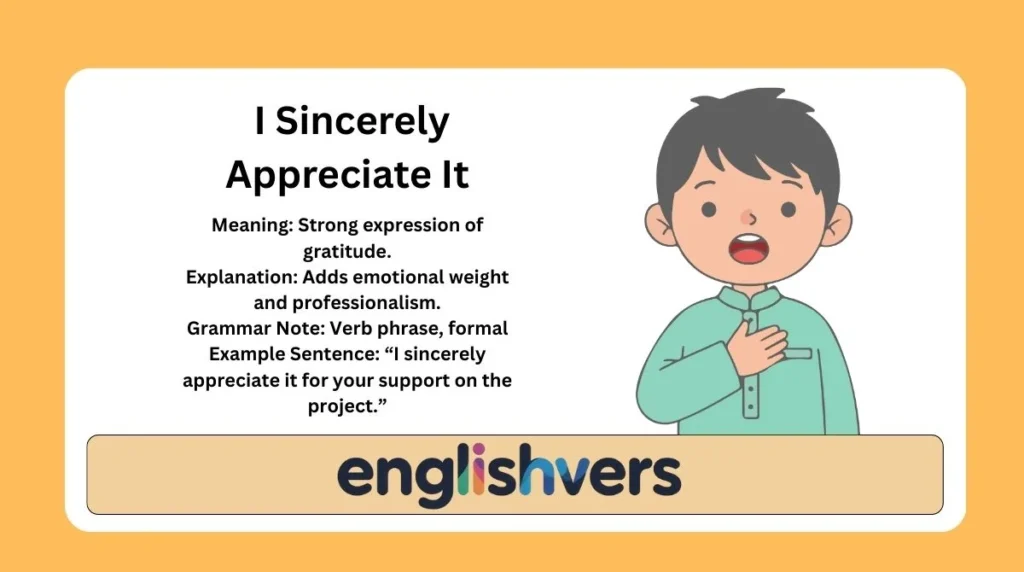
Meaning: Strong expression of gratitude.
Explanation: Adds emotional weight and professionalism.
Grammar Note: Verb phrase, formal
Example Sentence: “I sincerely appreciate it for your support on the project.”
Best Use: Business emails, meetings
Worst Use: Informal social messages
Tone: Formal, professional
Level: Advanced
Similarity Score: 10/10
Replaceability Tip: Use to convey seriousness.
6. Much Obliged
Meaning: Traditional way to say thank you.
Explanation: Slightly old-fashioned but polite.
Grammar Note: Adjective phrase
Example Sentence: “I am much obliged for your help with the documents.”
Best Use: Formal letters, British English
Worst Use: Casual American English
Tone: Formal, polite
Level: Advanced
Similarity Score: 8/10
Replaceability Tip: Best for formal or literary contexts.
7. Thanks for Being There
Meaning: Expresses emotional gratitude.
Explanation: Great for personal or supportive contexts.
Grammar Note: Informal phrase
Example Sentence: “Thanks for being there when I needed you.”
Best Use: Friends, family, casual work context
Worst Use: Academic writing
Tone: Friendly, soft
Level: Beginner
Similarity Score: 6/10
Replaceability Tip: Use for emotional support acknowledgment.
8. I Value Your Support
Meaning: Highlights respect and appreciation.
Explanation: Professional, conveys recognition.
Grammar Note: Verb phrase
Example Sentence: “I value your support in achieving our goals.”
Best Use: Workplace, business meetings
Worst Use: Informal texting
Tone: Formal, professional
Level: Intermediate
Similarity Score: 9/10
Replaceability Tip: Use to express respect in professional contexts.
9. Heartfelt Thanks
Meaning: Deep, sincere gratitude.
Explanation: Emphasizes emotion over formality.
Grammar Note: Adjective + noun
Example Sentence: “Heartfelt thanks for your assistance during the conference.”
Best Use: Cards, emails, personal notes
Worst Use: Casual texting
Tone: Soft, sincere
Level: Intermediate
Similarity Score: 8/10
Replaceability Tip: Use when emotion is important.
10. I Am Thankful for Your Support
Meaning: Polite and formal alternative.
Explanation: Simple yet effective in professional writing.
Grammar Note: Verb phrase
Example Sentence: “I am thankful for your support throughout this initiative.”
Best Use: Workplace, formal emails
Worst Use: Casual texting
Tone: Formal, polite
Level: Beginner
Similarity Score: 9/10
Replaceability Tip: Good for clear, professional writing.
11. Appreciated
Meaning: Short and concise gratitude.
Explanation: Modern, informal, often in quick messages.
Grammar Note: Past participle used informally
Example Sentence: “Your help with the project is really appreciated.”
Best Use: Emails, texts
Worst Use: Formal letters
Tone: Neutral, informal
Level: Beginner
Similarity Score: 7/10
Replaceability Tip: Ideal for fast acknowledgment.
12. Thanks a Million
Meaning: Informal, strong gratitude.
Explanation: Adds friendliness and warmth.
Grammar Note: Idiomatic expression
Example Sentence: “Thanks a million for your support in setting this up!”
Best Use: Friends, social media
Worst Use: Formal writing
Tone: Friendly, casual
Level: Beginner
Similarity Score: 6/10
Replaceability Tip: Use when you want to sound enthusiastic.
Mini Dialogue Examples
Formal Dialogue:
A: “Thank you for your support in the presentation.”
B: “I sincerely appreciate it. Glad I could help.”
Informal Dialogue:
A: “Hey, thanks for being there yesterday!”
B: “No problem! Always got your back.”
Business Email Example:
Subject: Project Support
“Dear Mr. Smith,
I am truly grateful for your support on the client proposal. Your guidance was invaluable.
Best regards,
Sarah Lee”
Mistakes to Avoid
- Overusing “thank you” in one email or conversation
- Using informal alternatives in formal emails
- Ignoring tone differences between UK and US English
- Using clichés like “thanks a ton” in professional contexts
- Forgetting to specify what you are thankful for
- Confusing “appreciate” with casual slang
- Using “much obliged” in casual texting
Cultural & Tone Tips
- UK English: Polite, formal expressions like “much obliged” are common.
- US English: Friendly and direct gratitude like “thanks a lot” is preferred.
- Casual Social English: Short, informal phrases like “thanks for being there” are natural.
Comparison Table of Best Alternatives
| Phrase | Tone | Best Context | Professional Level | Example |
|---|---|---|---|---|
| I truly appreciate your help | Formal | Email, workplace | High | “I truly appreciate your help with the report.” |
| Many thanks for your support | Friendly | Email, social media | Medium | “Many thanks for your support in this campaign.” |
| Grateful for your assistance | Polite | Academic, workplace | High | “I am grateful for your assistance.” |
| Thanks a lot for your help | Informal | Casual conversation | Low | “Thanks a lot for your help moving!” |
| I sincerely appreciate it | Formal | Email, professional | High | “I sincerely appreciate it for your support.” |
| Thanks for being there | Friendly | Personal, informal | Low | “Thanks for being there yesterday!” |
FAQs
Is “thank you for your support” rude?
No, it is always polite and appreciated.
Is it okay in emails?
Yes, very common in professional and casual emails.
What is the most formal alternative?
“I sincerely appreciate your assistance” is highly formal.
What is the most polite alternative?
“Grateful for your assistance” is polite and respectful.
What should beginners use?
“Thanks a lot for your help” or “Many thanks” are simple and safe.
Can it be used in social media?
Yes, short versions like “Thanks for your support” work well.
Conclusion
Using alternatives to “thank you for your support” helps you communicate gratitude in clear, varied, and context-appropriate ways.
Different phrases carry different tones, from formal to casual, and allow you to express sincerity, friendliness, or professionalism.
Practicing these alternatives improves writing, speaking, and email communication.
By mastering varied expressions, you make your English richer, more polished, and engaging.
Gratitude becomes not just a phrase, but a skill that strengthens relationships in business and daily life.

Ethan Cole is a passionate language enthusiast dedicated to making English learning simple and enjoyable.