
The phrase “Where are you going?” is one of the most common questions in English. It asks about a person’s destination or plans.
While simple, using the same phrase repeatedly can feel repetitive, casual, or even abrupt depending on the context.
Learning alternative ways to express this idea helps English learners and professionals communicate more naturally, politely, and effectively. Word choice can influence tone, clarity, and professionalism.
For instance, saying “Where are you going?” in a business email may sound too direct, whereas “May I ask where you are headed?” feels polite and professional.
Using varied expressions enhances conversation, improves writing, and ensures your tone matches the situation.
What Does “Where Are You Going?” Mean?
Definition:
“Where are you going?” asks about someone’s current or future destination. It is a question about movement or plans.
Grammar Form:
- Interrogative sentence
- Verb: “are going” (present continuous)
- Pronoun: “you” (subject)
Synonyms:
- Heading to, off to, going toward, on your way to
Opposites / Other Tones:
- “Where have you been?” (past focus)
- “Stay here” (imperative, opposite meaning)
Example Sentences:
- Informal: “Where are you going after class?”
- Formal: “May I ask where you are headed this afternoon?”
When to Use “Where Are You Going?”
Spoken English:
Perfect for casual conversation with friends or family. Avoid overuse in formal settings.
Business English:
Use with polite phrasing, e.g., “Could you let me know your next destination?”
Emails / Messages:
Opt for professional alternatives rather than the direct phrase.
Social Media:
Informal usage works, especially in comments or DMs: “Where you heading?”
Academic Writing:
Rarely needed, unless quoting dialogue. Use formal phrases if required.
Professional Meetings:
Phrase with softening language or indirect inquiry is preferred.
Is “Where Are You Going?” Polite or Professional?
- Polite: Neutral in casual speech but can sound abrupt in formal contexts.
- Neutral: Works with friends and family.
- Strong: Overly direct in workplace or academic writing.
- Soft: Use with words like “may I ask” or “could you tell me.”
- Formal vs Informal: Informal with peers; formal alternatives needed for business, email, or academic use.
Etiquette Tip: Avoid using the direct question in corporate emails; choose a professional phrasing instead.
Pros & Cons of Using “Where Are You Going?”
✔ Pros:
- Simple and widely understood
- Works in casual conversation
- Direct and clear
✘ Cons:
- Can sound abrupt or rude in formal contexts
- Limited variety in professional writing
- May not reflect politeness or social nuance
Quick Alternatives List (One-Line Phrases Only)
- Where are you headed?
- Where are you off to?
- Where to next?
- May I ask where you are going?
- What’s your next stop?
- Where’s your destination?
- Where are you traveling?
- Where do you plan to go?
- What’s your next move?
- Where are you bound for?
- Could you tell me where you’re going?
- Where are you making your way to?
- On your way somewhere?
- Heading anywhere?
- Which way are you going?
15 Alternatives with Detailed Explanation
1. Where are you headed?
Meaning: Asks about someone’s destination.
Explanation: Neutral, polite, commonly used in spoken English.
Grammar Note: Informal phrasal verb.
Example Sentence: “Where are you headed after work?”
Best Use: Informal, text messages, spoken English
Worst Use: Formal emails without softening language
Tone: Friendly / Neutral
Level: Beginner
Similarity Score: 9
Replaceability Tip: Use in casual conversation instead of the original.
2. Where are you off to?
Meaning: Asking about plans or destination.
Explanation: Very casual and conversational, common in British English.
Grammar Note: Phrasal verb + preposition.
Example Sentence: “Where are you off to this weekend?”
Best Use: Informal, social media, daily chat
Worst Use: Corporate emails, professional meetings
Tone: Friendly
Level: Beginner
Similarity Score: 8
Replaceability Tip: Perfect for friends or family; avoids sounding stiff.
3. Where to next?
Meaning: Short, conversational way to ask someone’s next destination.
Explanation: Casual, playful, often used when following someone’s journey or plans.
Grammar Note: Informal interrogative.
Example Sentence: “We visited London and Paris. Where to next?”
Best Use: Informal conversation, travel blogs
Worst Use: Formal writing or corporate contexts
Tone: Casual / Playful
Level: Intermediate
Similarity Score: 7
Replaceability Tip: Good for spoken English; not suitable for business.
4. May I ask where you are going?
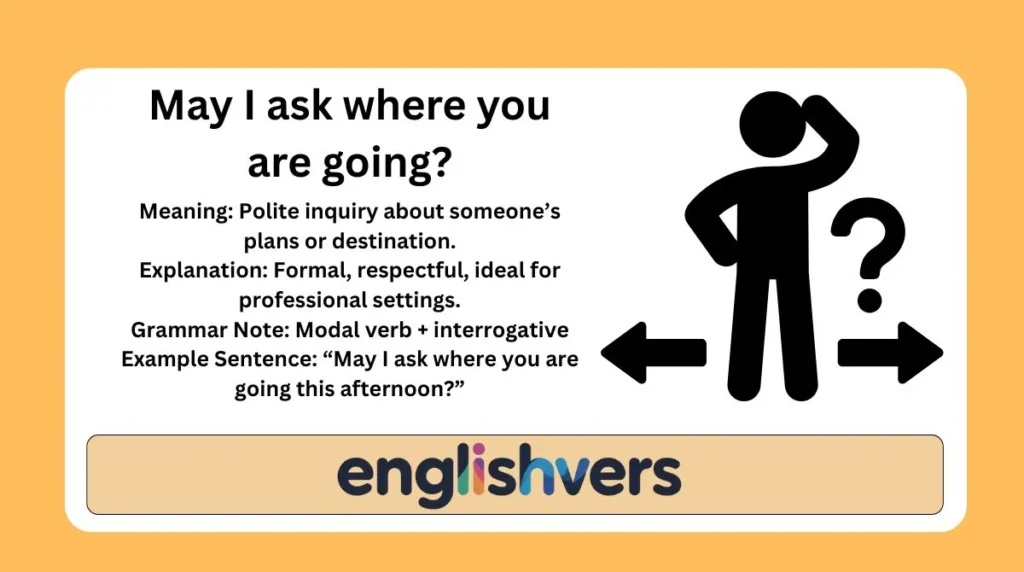
Meaning: Polite inquiry about someone’s plans or destination.
Explanation: Formal, respectful, ideal for professional settings.
Grammar Note: Modal verb + interrogative
Example Sentence: “May I ask where you are going this afternoon?”
Best Use: Emails, workplace, professional meetings
Worst Use: Casual chats among close friends
Tone: Formal / Polite
Level: Intermediate
Similarity Score: 9
Replaceability Tip: Use in professional or academic contexts.
5. What’s your next stop?
Meaning: Asks about the immediate next destination.
Explanation: Neutral, slightly informal, good for both travel and work contexts.
Grammar Note: Informal phrase with noun “stop”
Example Sentence: “We’ve finished the first session. What’s your next stop?”
Best Use: Casual, semi-formal conversation
Worst Use: Academic writing
Tone: Neutral / Friendly
Level: Intermediate
Similarity Score: 8
Replaceability Tip: Use in travel or journey-related discussion.
6. Where’s your destination?
Meaning: Inquiring about the person’s planned endpoint.
Explanation: Slightly more formal, works in written English.
Grammar Note: Noun phrase
Example Sentence: “Could you tell me where’s your destination for the conference?”
Best Use: Professional, email
Worst Use: Casual spoken English
Tone: Formal / Neutral
Level: Advanced
Similarity Score: 9
Replaceability Tip: Ideal for formal inquiries.
7. Where are you traveling?
Meaning: Asking about movement from one place to another.
Explanation: Neutral, often used for longer journeys.
Grammar Note: Present continuous
Example Sentence: “Where are you traveling during the holidays?”
Best Use: Travel, casual conversation
Worst Use: Workplace emails without context
Tone: Neutral / Friendly
Level: Beginner
Similarity Score: 8
Replaceability Tip: Use when travel context is implied.
8. Where do you plan to go?
Meaning: Inquiring about someone’s intentions or destination.
Explanation: Formal or semi-formal; polite and slightly indirect.
Grammar Note: Present simple + verb phrase
Example Sentence: “Where do you plan to go after graduation?”
Best Use: Formal, academic, workplace
Worst Use: Casual speech with friends
Tone: Formal / Neutral
Level: Intermediate
Similarity Score: 9
Replaceability Tip: Use when politeness and clarity are needed.
9. What’s your next move?
Meaning: Asking about plans or decisions, not necessarily physical movement.
Explanation: Informal, can be metaphorical in business strategy.
Grammar Note: Noun phrase
Example Sentence: “You finished the first project. What’s your next move?”
Best Use: Informal, professional strategy discussions
Worst Use: Casual travel conversation
Tone: Neutral / Professional
Level: Advanced
Similarity Score: 6
Replaceability Tip: Use metaphorically in professional settings.
10. Where are you bound for?
Meaning: Asking about the planned direction or destination.
Explanation: Slightly formal or literary, less common in spoken English.
Grammar Note: Phrasal verb “bound for”
Example Sentence: “Where are you bound for on this journey?”
Best Use: Formal writing, travel blogs
Worst Use: Casual text messages
Tone: Formal / Neutral
Level: Advanced
Similarity Score: 8
Replaceability Tip: Adds variety in formal writing.
11. Could you tell me where you’re going?
Meaning: Polite inquiry about someone’s location or plans.
Explanation: Formal, respectful, avoids directness.
Grammar Note: Modal verb + indirect question
Example Sentence: “Could you tell me where you’re going after the meeting?”
Best Use: Emails, workplace, polite conversation
Worst Use: Very casual chats
Tone: Formal / Polite
Level: Intermediate
Similarity Score: 9
Replaceability Tip: Safe professional alternative.
12. Where are you making your way to?
Meaning: Asks politely about someone’s destination.
Explanation: Neutral, slightly formal, works for spoken and written English.
Grammar Note: Present continuous + phrasal verb
Example Sentence: “Where are you making your way to after lunch?”
Best Use: Workplace, casual conversation
Worst Use: Very informal chats
Tone: Neutral / Polite
Level: Intermediate
Similarity Score: 8
Replaceability Tip: Smooth alternative for polite conversation.
13. On your way somewhere?
Meaning: Casual check on whether someone is traveling.
Explanation: Informal, friendly, neutral tone.
Grammar Note: Idiomatic question
Example Sentence: “Hey, on your way somewhere or just taking a walk?”
Best Use: Informal, friends, social media
Worst Use: Workplace, professional emails
Tone: Friendly / Casual
Level: Beginner
Similarity Score: 7
Replaceability Tip: Perfect for checking casually.
14. Heading anywhere?
Meaning: Informal inquiry about direction or plans.
Explanation: Casual and neutral, often spoken quickly.
Grammar Note: Present participle + informal interrogative
Example Sentence: “Heading anywhere tonight?”
Best Use: Casual conversation, social media
Worst Use: Formal writing
Tone: Casual / Friendly
Level: Beginner
Similarity Score: 7
Replaceability Tip: Use with friends or informal groups.
15. Which way are you going?
Meaning: Asks about the route or path someone is taking.
Explanation: Neutral, slightly direct, can be spoken or written.
Grammar Note: Interrogative sentence
Example Sentence: “Which way are you going from here?”
Best Use: Spoken English, navigation
Worst Use: Formal emails without softening
Tone: Neutral / Friendly
Level: Beginner
Similarity Score: 8
Replaceability Tip: Good for physical directions or casual use.
Mini Dialogue Examples
Formal Dialogue:
A: “May I ask where you are headed this afternoon?”
B: “Yes, I’m going to the client meeting downtown.”
Informal Dialogue:
A: “Where are you off to?”
B: “Just grabbing some coffee. Want to join?”
Business Email Example:
Subject: Clarification on Your Schedule
“Hi John,
Could you tell me where you’re going after the team meeting? I want to coordinate our follow-up discussion.
Thanks,
Sarah”
Mistakes to Avoid
- Using the direct phrase in formal emails (“Where are you going?”).
- Mixing informal phrases in professional meetings.
- Overusing the same phrase repeatedly in writing or speech.
- Using casual phrasal verbs like “off to” in academic papers.
- Forgetting context—some phrases are literal, others metaphorical.
- Ignoring tone—some alternatives may sound too casual or too formal.
- Using slang in workplace correspondence.
Cultural & Tone Tips
- UK English: “Where are you off to?” is common and friendly.
- US English: “Where are you headed?” is widely understood.
- Casual Social English: Short phrases like “Heading anywhere?” or “Where to next?” feel natural.
- Professional Tone: Always soften direct questions with “may I ask” or “could you tell me.”
Comparison Table of Best Alternatives
| Phrase | Tone | Best Context | Professional Level | Example |
|---|---|---|---|---|
| Where are you headed? | Friendly | Conversation, text | Neutral | “Where are you headed after work?” |
| May I ask where you are going? | Polite | Email, workplace | High | “May I ask where you are going today?” |
| Where are you off to? | Casual | Social chats | Low | “Where are you off to this weekend?” |
| What’s your next stop? | Neutral | Travel, semi-formal | Medium | “What’s your next stop after London?” |
| Could you tell me where you’re going? | Polite | Workplace, email | High | “Could you tell me where you’re going after lunch?” |
FAQs
Is “Where are you going?” rude?
It can be abrupt in formal or professional contexts.
Is it okay in emails?
Direct form is not recommended; use polite alternatives.
What is the most formal alternative?
“May I ask where you are headed?”
What is the most polite alternative?
“Could you tell me where you’re going?”
What should beginners use?
“Where are you headed?” or “Where are you off to?”
Can it be used socially?
Yes, informal variations are perfect for friends and family.
Conclusion
Using alternatives to “Where are you going?” helps learners and professionals communicate clearly, politely, and effectively.
Choosing the right expression improves tone, builds relationships, and enhances writing.
Practicing varied phrases in daily conversation, emails, and social settings ensures English sounds natural, fluent, and appropriate in every situation.

Ethan Cole is a passionate language enthusiast dedicated to making English learning simple and enjoyable.