
“Sorry for the short notice” is a common phrase used when you inform someone of something later than expected.
It may be a meeting, a request, a schedule change, or an invitation shared too close to the time of the event.
While this phrase communicates apology and awareness, English offers many alternatives that express the same idea with more politeness, more professionalism, or more warmth—depending on the situation.
Having a range of expressions improves communication. In workplaces, word choice can shape trust, respect, and clarity. In daily conversation, it affects friendliness and tone.
Using varied language helps when writing emails, messages, academic work, social posts, or business documents. For example:
- Formal: I apologize for the late notice.
- Informal: Sorry for the heads-up so late!
Both are correct—but they carry different tone and feeling. That is why learning alternatives matters for English learners, employees, leaders, and professionals.
What Does “Sorry for the Short Notice” Mean?
It means you feel sorry because you informed someone about something only a short time before it was needed or expected.
It functions as a polite expression / apology phrase.
Synonyms:
late update, last-minute notice, late communication
Opposite tone: advanced notice, early reminder, timely update
Sample sentences:
- Sorry for the short notice, but the meeting is starting in 30 minutes.
- Sorry for the short notice; I just received the information myself.
When to Use This Phrase
Spoken English
Used to sound polite when changing plans or inviting someone quickly.
Business English
Used when schedules, deadlines, or team plans shift unexpectedly.
Emails / Messages
Common in professional, academic, and school communication.
Social Media
Used for event announcements, live streams, updates, or sudden cancellations.
Academic Writing
Sometimes used when writing to professors or institutions regarding submissions or meetings.
Professional Meetings
Used to open a statement when announcing decisions or adjustments.
Is “Sorry for the Short Notice” Polite or Professional?
This phrase is polite, neutral, and commonly acceptable in workplaces. It shows awareness of inconvenience.
However, the tone changes depending on the speaker:
- Polite: shows courtesy and respect
- Neutral: factual yet still humble
- Soft tone: reduces pressure or blame
- Strong tone: used when the delay causes impact
Formal vs Informal
- Formal: I sincerely apologize for the late notice.
- Informal: My bad for the short notice!
Etiquette Tip:
Avoid slang in corporate or external business emails.
Pros & Cons of Using This Phrase
✔ Pros
- Polite
- Easy to understand
- Works in emails and speech
- Sounds respectful
✘ Cons
- Overused
- Can seem generic
- May sound weak in serious situations
Quick Alternatives List (Short Replacements)
Here are fast alternatives:
- Please excuse the late notice
- My apologies for informing you so late
- I apologize for the late update
- Sorry for the last-minute change
- Sorry for the delay in sharing this
- Sorry for getting back to you late
- Thank you for your flexibility
- Thanks for understanding the short notice
- Sorry for not letting you know sooner
- Apologies this is last minute
- I hope this short notice is okay
- I realize this comes late
- Sorry for the rushed request
- Apologies for the sudden schedule change
- I regret not notifying you earlier
- Forgive the sudden message
- Thanks for your quick attention
- Appreciate your quick response on this
- Sorry for dropping this on you last minute
Polite Alternatives to “Sorry for the Short Notice”
Below are more complete, natural, and useful options with detailed meaning and usage guidance.
1. “Please excuse the late notice.”
Meaning: A polite and formal apology for informing someone late.
Explanation: This sounds respectful and is often used in emails and business communication.
Grammar Note: Formal request phrase.
Example: Please excuse the late notice, but the deadline has been moved to tomorrow.
Best Use: Business / Email / Workplace
Worst Use: Casual texting
Tone: Formal, polite
Level: Intermediate
Similarity Score: 9/10
Replaceability Tip: Use when you want a respectful, refined tone.
2. “My apologies for informing you so late.”
Meaning: You are sorry and take responsibility for the delay.
Explanation: Sounds more considerate and professional than simply saying sorry.
Grammar Note: Noun phrase (apologies).
Example: My apologies for informing you so late, but we must submit the form today.
Best Use: Academic, corporate letters
Worst Use: Very casual chats
Tone: Very formal
Level: Advanced
Similarity Score: 10/10
Replaceability Tip: Use for serious or official context.
3. “I apologize for the late update.”
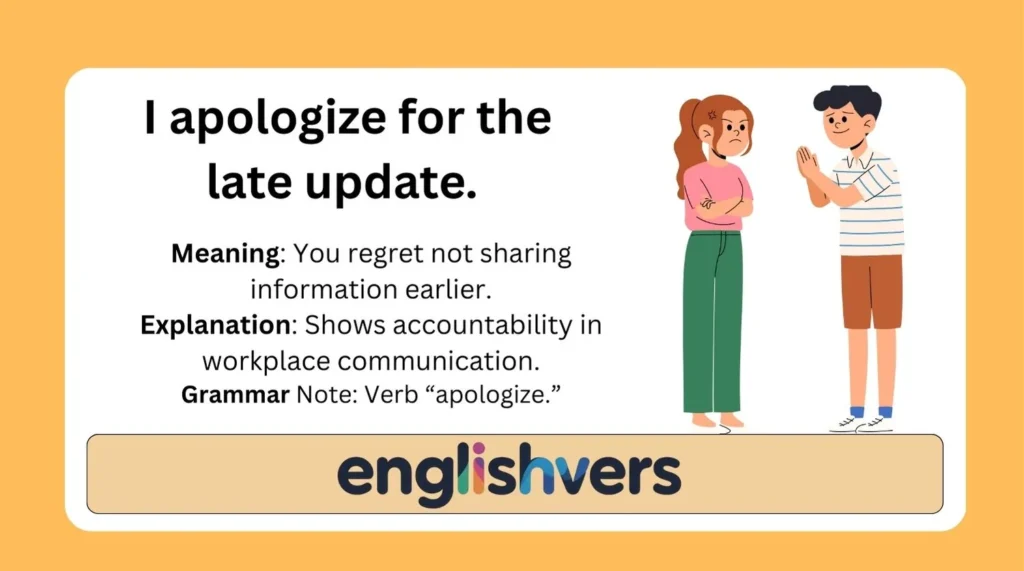
Meaning: You regret not sharing information earlier.
Explanation: Shows accountability in workplace communication.
Grammar Note: Verb “apologize.”
Example: I apologize for the late update regarding your request.
Best Use: Workplace / project management
Worst Use: Friends
Tone: Professional
Level: Intermediate
Similarity Score: 8/10
Replaceability Tip: Use when giving delayed information.
4. “Thank you for your patience and understanding.”
Meaning: Shows gratitude instead of direct apology.
Explanation: Good when the delay was unavoidable.
Grammar Note: Appreciation phrase.
Example: Thank you for your patience and understanding as we finalize the schedule.
Best Use: Customer service / diplomacy
Worst Use: When you truly need to say sorry
Tone: Soft, positive
Level: Beginner
Similarity Score: 6/10
Replaceability Tip: Use when the other person waited.
5. “Apologies for the last-minute request.”
Meaning: You regret asking someone at the final moment.
Explanation: Used when you need help urgently.
Grammar Note: Plural noun.
Example: Apologies for the last-minute request; could you review the document today?
Best Use: Urgent workplace tasks
Worst Use: Very formal writing
Tone: Neutral
Level: Intermediate
Similarity Score: 9/10
Replaceability Tip: Use for sudden help or action.
6. “I realize this comes late.”
Meaning: You acknowledge the timing issue.
Explanation: Subtle and softer than saying sorry.
Grammar Note: Realization statement.
Example: I realize this comes late, but could we reschedule?
Best Use: Friendly professional tone
Worst Use: When real apology needed
Tone: Soft
Level: Intermediate
Similarity Score: 7/10
Replaceability Tip: Good for texts or teams.
7. “I hope this short notice is okay.”
Meaning: Seeks permission politely.
Explanation: Sounds kind and considerate.
Grammar Note: Hope clause.
Example: I hope this short notice is okay, but can we meet today?
Best Use: Friendly colleagues or classmates
Worst Use: Corporate announcements
Tone: Friendly
Level: Beginner
Similarity Score: 7/10
Replaceability Tip: Use in gentle contexts.
8. “Sorry for not letting you know sooner.”
Meaning: You admit notifying late.
Explanation: Clear and honest.
Grammar Note: Gerund phrase.
Example: Sorry for not letting you know sooner, traffic changed the plan.
Best Use: Informal conversation
Worst Use: Very formal email
Tone: Casual / warm
Level: Beginner
Similarity Score: 8/10
Replaceability Tip: Use with friends or family.
9. “I regret not notifying you earlier.”
Meaning: Stronger apology showing awareness of consequences.
Explanation: Used when the delay matters.
Grammar Note: Formal verb (regret).
Example: I regret not notifying you earlier about the meeting change.
Best Use: Serious professional messages
Worst Use: Casual chats
Tone: Strong / formal
Level: Advanced
Similarity Score: 9/10
Replaceability Tip: Use when the delay caused a problem.
10. “Thanks for responding on such short notice.”
Meaning: Appreciation for quick reaction.
Explanation: Focuses on gratitude over apology.
Grammar Note: Thank-you phrase.
Example: Thanks for responding on such short notice—it means a lot.
Best Use: Appreciation emails
Worst Use: When you are the one causing inconvenience
Tone: Warm
Level: Beginner
Similarity Score: 5/10
Replaceability Tip: Good follow-up phrase.
11. “I appreciate your quick attention to this.”
Meaning: You value their time.
Explanation: Polite and professional.
Grammar Note: Appreciation phrase.
Example: I appreciate your quick attention to this matter.
Best Use: Corporate clients
Worst Use: Casual texting
Tone: Professional
Level: Intermediate
Similarity Score: 6/10
Replaceability Tip: Use after giving tasks.
12. “Sorry for the rushed request.”
Meaning: Apology for urgent action needed.
Explanation: Shows urgency honestly.
Grammar Note: Apology phrase.
Example: Sorry for the rushed request, could you approve it today?
Best Use: Workplace tasks
Worst Use: Academic letters
Tone: Neutral
Level: Beginner
Similarity Score: 8/10
Replaceability Tip: Good when deadlines changed fast.
Dialogue Examples
Formal
A: Please excuse the late notice; the meeting has been moved to Monday.
B: Thank you for informing me.
Informal
A: Sorry for not telling you sooner—plans changed.
B: No worries!
Business email style
My apologies for the last-minute request. Could you share the report by today? I truly appreciate your quick support.
Mistakes to Avoid
- Saying “Sorry for short notice” (missing article “the”).
- Using slang in professional emails.
- Over-apologizing repeatedly in one message.
- Saying sorry without offering context.
- Making the apology sound sarcastic.
- Saying sorry but still sounding demanding.
Cultural & Tone Tips
UK English
More indirect and polite forms preferred. Soft tone appreciated.
US English
Direct yet friendly forms common. Efficiency-valued.
Casual Social English
Short forms: Sorry for the late heads-up! or My bad! depending on group.
Native speakers respond better when apology + appreciation are combined.
Comparison Table — Popular Alternatives
| Phrase | Tone | Best Context | Professional Level | Example |
|---|---|---|---|---|
| Please excuse the late notice | Formal | High | Please excuse the late notice. | |
| Apologies for the last-minute request | Neutral | Workplace | Medium | Apologies for the last-minute request. |
| I regret not notifying you earlier | Strong formal | Serious issues | High | I regret not notifying you earlier. |
| I hope this short notice is okay | Soft | Friendly | Low | I hope this short notice is okay. |
| Sorry for the rushed request | Neutral | Urgent tasks | Low | Sorry for the rushed request. |
FAQs
Is “sorry for the short notice” rude?
No, it is polite and commonly used.
Is it okay in emails?
Yes, especially with coworkers, clients, and academic staff.
What is the most formal alternative?
“I sincerely apologize for the late notice.”
What is the softest and friendliest?
“I hope this short notice is okay.”
What should beginners use?
“Sorry for the late notice.”
Which is best in business?
“Please excuse the late notice” or “My apologies for informing you so late.”
Conclusion
Using different ways to say “sorry for the short notice” helps you sound natural and confident.
The right phrase can show respect, soften messages, improve workplace communication, and express emotion more clearly.
These alternatives give you more power and flexibility in speaking and writing.
Try them in real conversations, emails, and messages.
With practice, choosing the right tone becomes easy and automatic, helping you communicate better in both professional and personal life.

Ethan Cole is a passionate language enthusiast dedicated to making English learning simple and enjoyable.