
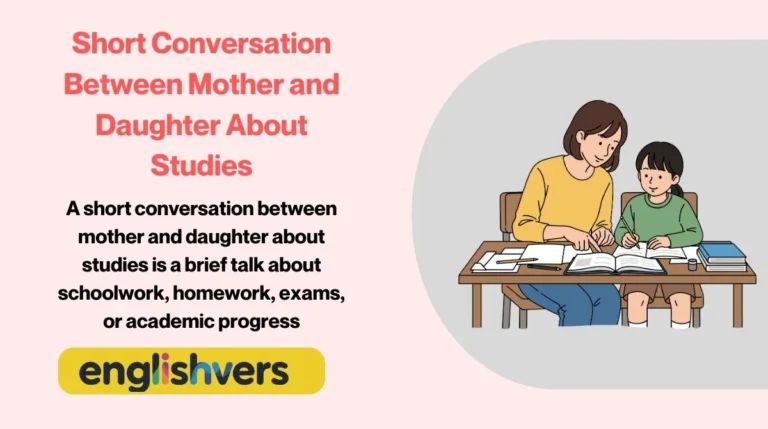
A short conversation between mother and daughter about studies is a brief talk about schoolwork, homework, exams, or academic progress. It may be caring, serious, supportive, or even strict.
But using the same phrase again and again can sound repetitive. In English, word choice matters. The right phrase can sound warm, professional, respectful, or casual. The wrong one can feel awkward or unclear.
In business writing, emails, essays, or daily speech, varied language shows fluency. It improves clarity. It also helps you sound natural like a native speaker.
Example contrast:
- Informal: Mom and I had a quick chat about my homework.
- Formal: I had a brief academic discussion with my mother.
Both mean the same thing. But the tone is different.
Let’s explore better ways to say it.
What Does “Short Conversation Between Mother and Daughter About Studies” Mean?
It means a brief discussion where a mother and daughter talk about school-related topics.
This phrase is a noun phrase. It describes an event or interaction.
Simple definition:
A quick talk between a mother and her daughter about schoolwork.
Similar tone phrases:
- Quick study talk
- Brief academic chat
- Homework discussion
Opposite tone:
- Long academic debate
- Detailed academic meeting
Example sentences:
- They had a short conversation about her exam results.
- The mother discussed her daughter’s school performance briefly.
When to Use This Phrase
Spoken English
Good for storytelling. Example: We had a short conversation about my grades.
Business English
Better to use formal alternatives like brief academic discussion.
Emails / Messages
Use softer phrases like quick check-in about studies.
Social Media
Informal versions like homework chat with mom work better.
Academic Writing
Use formal terms like academic discussion.
Professional Meetings
If referring to parent involvement, use brief parent-student academic discussion.
Is This Phrase Polite or Professional?
The phrase is neutral.
Tone levels:
- Polite: Yes
- Neutral: Yes
- Strong: No
- Soft: Yes
- Formal: Slightly
- Informal: Can be
Etiquette Tip:
In corporate emails or school reports, avoid long descriptive phrases. Use concise alternatives like academic discussion or study-related discussion.
Pros & Cons of Using the Phrase
✔ Pros:
- Clear meaning
- Easy to understand
- Safe and neutral
✘ Cons:
- Too long
- Not natural in daily speech
- Sounds robotic in professional writing
Quick Alternatives List
- Quick study chat
- Brief academic discussion
- Homework talk
- Study check-in
- Academic conversation
- Parent-daughter study talk
- Schoolwork discussion
- Learning progress talk
- Exam discussion
- Performance review talk
- Study-related conversation
- Homework review
- Academic check-up
- Quick school update
- Study progress discussion
- Education-focused chat
- Academic guidance talk
17 Powerful Alternatives Explained
1. Quick Study Chat
Meaning: A short talk about studies.
Explanation: Casual and friendly.
Grammar Note: Informal phrase.
Example: We had a quick study chat after dinner.
Best Use: Informal / Text message
Worst Use: Academic reports
Tone: Friendly
Level: Beginner
Similarity Score: 9/10
Replaceability Tip: Use in relaxed family context.
2. Brief Academic Discussion
Meaning: Short formal talk about studies.
Explanation: Sounds professional and structured.
Grammar Note: Formal noun phrase.
Example: They held a brief academic discussion.
Best Use: Academic / Workplace
Worst Use: Casual social media
Tone: Formal
Level: Intermediate
Similarity Score: 8/10
Replaceability Tip: Best for reports.
3. Homework Talk
Meaning: Conversation about homework.
Explanation: Simple and common.
Grammar Note: Compound noun phrase.
Example: We had a homework talk tonight.
Best Use: Spoken English
Worst Use: Professional emails
Tone: Neutral
Level: Beginner
Similarity Score: 7/10
Replaceability Tip: Use when topic is homework only.
4. Study Check-In
Meaning: Quick update about studies.
Explanation: Supportive tone.
Grammar Note: Noun phrase.
Example: Mom did a study check-in.
Best Use: Emails / School settings
Worst Use: Academic research papers
Tone: Soft
Level: Intermediate
Similarity Score: 8/10
5. Academic Conversation
Meaning: Talk related to education.
Explanation: Broad and neutral.
Grammar Note: Formal noun phrase.
Example: They had an academic conversation.
Best Use: Essays
Worst Use: Text messages
Tone: Neutral
Level: Intermediate
Similarity Score: 7/10
6. Schoolwork Discussion
Meaning: Talk about school tasks.
Explanation: Clear and direct.
Grammar Note: Noun phrase.
Example: A schoolwork discussion took place.
Best Use: Parent meetings
Worst Use: Casual slang context
Tone: Professional
Level: Beginner
Similarity Score: 9/10
7. Learning Progress Talk
Meaning: Talk about improvement in studies.
Explanation: Focus on growth.
Grammar Note: Descriptive phrase.
Example: They had a learning progress talk.
Best Use: Academic settings
Worst Use: Casual texting
Tone: Professional
Level: Intermediate
Similarity Score: 6/10
8. Exam Discussion
Meaning: Talk about exams.
Explanation: Specific to tests.
Grammar Note: Noun phrase.
Example: They had an exam discussion.
Best Use: School environment
Worst Use: When not about exams
Tone: Neutral
Level: Beginner
Similarity Score: 7/10
9. Study-Related Conversation
Meaning: Any talk connected to studies.
Explanation: Flexible and neutral.
Grammar Note: Hyphenated phrase.
Example: They had a study-related conversation.
Best Use: Semi-formal writing
Worst Use: Very casual speech
Tone: Neutral
Level: Intermediate
Similarity Score: 8/10
10. Homework Review
Meaning: Going over homework together.
Explanation: Slightly structured tone.
Grammar Note: Noun phrase.
Example: They did a homework review.
Best Use: Parent-child setting
Worst Use: General academic essays
Tone: Neutral
Level: Beginner
Similarity Score: 6/10
11. Academic Check-Up
Meaning: Quick review of study performance.
Explanation: Feels supportive.
Grammar Note: Informal academic phrase.
Example: Mom had an academic check-up with her.
Best Use: School newsletters
Worst Use: Formal research papers
Tone: Soft
Level: Intermediate
Similarity Score: 7/10
12. Quick School Update
Meaning: Brief update about school matters.
Explanation: Light and modern tone.
Grammar Note: Informal phrase.
Example: They shared a quick school update.
Best Use: Text / Social media
Worst Use: Academic journal
Tone: Friendly
Level: Beginner
Similarity Score: 8/10
13. Study Progress Discussion
Meaning: Talk about academic improvement.
Explanation: Goal-focused tone.
Grammar Note: Formal phrase.
Example: They had a study progress discussion.
Best Use: School reports
Worst Use: Casual conversation
Tone: Professional
Level: Advanced
Similarity Score: 7/10
14. Education-Focused Chat
Meaning: Informal talk about education.
Explanation: Balanced tone.
Grammar Note: Compound phrase.
Example: They had an education-focused chat.
Best Use: Blogs
Worst Use: Corporate documents
Tone: Semi-formal
Level: Intermediate
Similarity Score: 7/10
15. Academic Guidance Talk
Meaning: Advice-based study conversation.
Explanation: Implies mentoring.
Grammar Note: Noun phrase.
Example: The mother gave an academic guidance talk.
Best Use: Counseling context
Worst Use: Casual speech
Tone: Formal
Level: Advanced
Similarity Score: 6/10
16. Performance Review Talk
Meaning: Talk about results and grades.
Explanation: Slightly serious tone.
Grammar Note: Professional phrase.
Example: They had a performance review talk.
Best Use: Formal setting
Worst Use: Friendly chat
Tone: Strong
Level: Advanced
Similarity Score: 6/10
17. Parent-Daughter Study Discussion
Meaning: Direct description of study talk.
Explanation: Clear and descriptive.
Grammar Note: Compound noun phrase.
Example: A parent-daughter study discussion occurred.
Best Use: Essays
Worst Use: Casual texting
Tone: Neutral
Level: Intermediate
Similarity Score: 9/10
Mini Dialogue Examples
Formal Dialogue
Mother: I would like to have a brief academic discussion about your grades.
Daughter: Sure, Mom. Let’s review them together.
Informal Dialogue
Mom: Let’s have a quick study chat.
Daughter: Okay, I’ll bring my notebook.
Business Email Style
Subject: Study Progress Discussion
Dear Mrs. Khan,
We recently had a study progress discussion regarding your daughter’s performance.
Mistakes to Avoid
- Using very formal phrases in casual speech
- Saying “academic talk” without context
- Mixing informal slang with formal writing
- Using long phrases in text messages
- Forgetting hyphen in “study-related”
- Overusing one expression repeatedly
Cultural & Tone Tips
In US English, casual phrases like homework chat sound natural.
In UK English, academic discussion sounds common in school settings.
In casual social English, shorter phrases work best.
Parents often prefer softer phrases like study check-in rather than strong ones like performance review.
Comparison Table
| Phrase | Tone | Best Context | Professional Level | Example |
|---|---|---|---|---|
| Quick Study Chat | Friendly | Home | Low | We had a quick study chat. |
| Brief Academic Discussion | Formal | School report | High | They had a brief academic discussion. |
| Study Check-In | Soft | Medium | She did a study check-in. | |
| Schoolwork Discussion | Neutral | Parent meeting | Medium | A schoolwork discussion happened. |
| Study Progress Discussion | Professional | Academic | High | They held a study progress discussion. |
FAQs
Is this phrase rude?
No. It is neutral and safe.
Is it okay in emails?
Yes, but shorter alternatives are better.
What is the most formal alternative?
Brief academic discussion.
What is the most polite alternative?
Study check-in.
What should beginners use?
Homework talk or Quick study chat.
Which sounds most professional?
Study progress discussion.
Conclusion
Using varied expressions improves your English. It helps you sound natural, confident, and clear. Instead of repeating one long phrase, choose alternatives based on tone and situation. Formal writing needs structured language. Casual speech needs simple words. Practice these phrases in real conversations. Try them in emails and essays. Over time, your fluency will grow naturally.

Ethan Cole is a passionate language enthusiast dedicated to making English learning simple and enjoyable.