
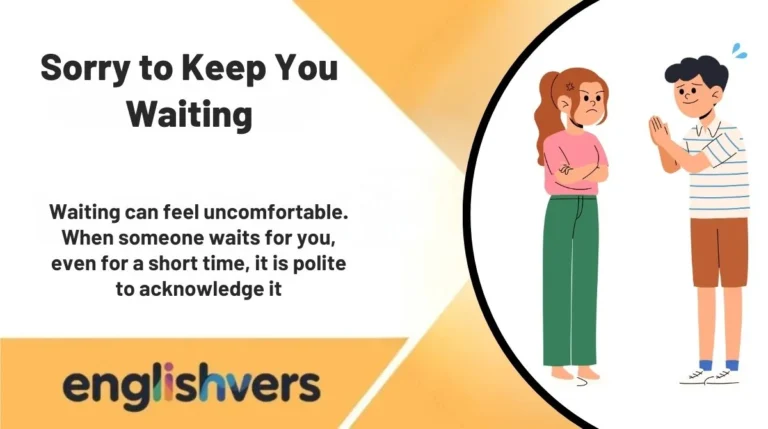
Waiting can feel uncomfortable. When someone waits for you, even for a short time, it is polite to acknowledge it. The phrase “sorry to keep you waiting” is a common and respectful way to do that. It shows awareness and courtesy.
But using the same sentence again and again can sound repetitive. In business, emails, meetings, or daily conversation, your word choice shapes your tone. A softer phrase sounds warm. A formal one sounds professional. A casual one sounds friendly.
For example:
- Formal: “Thank you for your patience.”
- Informal: “Sorry for the wait!”
Both work — but the feeling is different. That’s why learning alternatives improves fluency, confidence, and communication skills.
What Does “Sorry to Keep You Waiting” Mean?
Student-friendly definition:
It means you apologize because someone had to wait for you.
Grammar form:
It is a polite apology phrase. It includes the verb “sorry” + infinitive phrase “to keep you waiting.”
Simple synonyms:
- Sorry for the delay
- Thanks for waiting
- I appreciate your patience
Opposite tone:
- “You’ll have to wait.” (Direct, less polite)
Example sentences:
- Sorry to keep you waiting. Traffic was heavy.
- I’m sorry to keep you waiting. Let’s begin.
When to Use “Sorry to Keep You Waiting”
Spoken English
Use it when you arrive late or return after a delay. It sounds natural in daily life.
Business English
Good for client meetings, interviews, appointments, and customer service.
Emails / Messages
Works in professional emails if you respond late or delay a meeting.
Social Media
Less common, but fine in polite replies to followers or customers.
Academic Writing
Not usually used in essays. More suitable in academic presentations or meetings.
Professional Meetings
Very appropriate. It shows respect for others’ time.
Is “Sorry to Keep You Waiting” Polite or Professional?
This phrase is both polite and professional. But tone depends on context.
- Polite: Yes
- Neutral: Yes
- Soft: Yes
- Strong apology: Not very strong
- Formal: Moderately formal
- Informal: Acceptable
Etiquette Tip:
Better for workplace conversations and meetings.
In corporate emails, “Thank you for your patience” may sound more professional.
Pros & Cons of Using “Sorry to Keep You Waiting”
✔ Shows respect
✔ Acknowledges delay
✔ Works in most situations
✔ Easy to understand
✘ Can sound repetitive
✘ Slightly overused in business
✘ Not very strong if delay is serious
Quick Alternatives List
- Thank you for your patience
- Sorry for the delay
- I appreciate your understanding
- Apologies for the wait
- Thanks for waiting
- Sorry for the inconvenience
- I appreciate your time
- Thank you for hanging on
- Sorry to have kept you
- Thank you for bearing with me
- I’m grateful for your patience
- Sorry I’m late
- Thanks for sticking around
- My apologies
- Thank you for holding
- I didn’t mean to keep you waiting
- Appreciate your patience
- Sorry about the hold-up
- Thank you for waiting so patiently
Detailed Alternatives
Thank you for your patience
Meaning:
You appreciate someone for waiting calmly.
Explanation:
This shifts focus from apology to gratitude. It sounds confident and professional.
Grammar Note:
Formal gratitude phrase.
Example Sentence:
Thank you for your patience while I reviewed your file.
Best Use:
Email, workplace, customer service
Worst Use:
Very casual chats with friends
Tone: Professional, polite
Level: Beginner
Similarity Score: 9/10
Replaceability Tip:
Use this in formal emails instead of apologizing repeatedly.
Sorry for the delay
Meaning:
You apologize for being late.
Explanation:
Clear and direct. Suitable when the delay is noticeable.
Grammar Note:
Apology phrase with noun.
Example Sentence:
Sorry for the delay in responding.
Best Use:
Email, business
Worst Use:
When no delay happened
Tone: Neutral
Level: Beginner
Similarity Score: 8/10
Replaceability Tip:
Use when the focus is on time delay, not waiting physically.
I appreciate your understanding
Meaning:
You value someone’s patience and kindness.
Explanation:
Very professional. Implies the situation was unavoidable.
Grammar Note:
Gratitude statement.
Example Sentence:
I appreciate your understanding during this busy period.
Best Use:
Corporate communication
Worst Use:
Very small delays
Tone: Formal
Level: Intermediate
Similarity Score: 7/10
Apologies for the wait
Meaning:
A formal way to say sorry for making someone wait.
Explanation:
More refined than “sorry.” Good in customer service.
Grammar Note:
Formal noun-based apology.
Example Sentence:
Apologies for the wait. Your table is ready.
Best Use:
Hospitality, office settings
Worst Use:
Texting close friends
Tone: Formal
Level: Intermediate
Similarity Score: 9/10
Thanks for waiting
Meaning:
You thank someone for waiting.
Explanation:
Friendly and short. Less serious than a full apology.
Grammar Note:
Informal gratitude phrase.
Example Sentence:
Thanks for waiting! I’m ready now.
Best Use:
Casual settings
Worst Use:
Formal board meetings
Tone: Friendly
Level: Beginner
Similarity Score: 7/10
Sorry for the inconvenience
Meaning:
You apologize for causing trouble.
Explanation:
Stronger than “sorry to keep you waiting.” Used for bigger problems.
Grammar Note:
Formal apology phrase.
Example Sentence:
We’re sorry for the inconvenience caused.
Best Use:
Business announcements
Worst Use:
Tiny delays
Tone: Professional
Level: Intermediate
Similarity Score: 8/10
Thank you for bearing with me
Meaning:
You thank someone for staying patient during difficulty.
Explanation:
Used when something takes longer than expected.
Grammar Note:
Idiom phrase.
Example Sentence:
Thank you for bearing with me while I fix this.
Best Use:
Workplace, semi-formal
Worst Use:
Very formal legal letters
Tone: Warm professional
Level: Intermediate
Similarity Score: 7/10
Sorry I’m late
Meaning:
You apologize for arriving after the expected time.
Explanation:
Simple and common.
Grammar Note:
Direct apology sentence.
Example Sentence:
Sorry I’m late. The meeting ran long.
Best Use:
Spoken English
Worst Use:
Written corporate reports
Tone: Neutral
Level: Beginner
Similarity Score: 8/10
My apologies
Meaning:
A formal way to say sorry.
Explanation:
Short and respectful. Often used in professional emails.
Grammar Note:
Formal noun phrase.
Example Sentence:
My apologies for the delayed response.
Best Use:
Formal email
Worst Use:
Very casual texting
Tone: Formal
Level: Intermediate
Similarity Score: 8/10
Thank you for holding
Meaning:
Used when someone waits on the phone.
Explanation:
Common in customer service calls.
Grammar Note:
Telephone etiquette phrase.
Example Sentence:
Thank you for holding. How may I help you?
Best Use:
Phone conversations
Worst Use:
Face-to-face apology
Tone: Professional
Level: Beginner
Similarity Score: 6/10
I didn’t mean to keep you waiting
Meaning:
You explain that the delay was not intentional.
Explanation:
Adds sincerity and softness.
Grammar Note:
Full apology sentence.
Example Sentence:
I didn’t mean to keep you waiting. Thank you for staying.
Best Use:
Personal conversations
Worst Use:
Very formal documents
Tone: Soft
Level: Intermediate
Similarity Score: 9/10
Appreciate your patience
Meaning:
Shortened version of gratitude.
Explanation:
Common in quick emails and chats.
Grammar Note:
Elliptical phrase (subject omitted).
Example Sentence:
Appreciate your patience while we resolve this.
Best Use:
Work chats
Worst Use:
Formal letters
Tone: Neutral
Level: Intermediate
Similarity Score: 8/10
Sorry about the hold-up
Meaning:
Apology for a small delay.
Explanation:
Casual tone.
Grammar Note:
Informal phrase.
Example Sentence:
Sorry about the hold-up. Let’s continue.
Best Use:
Friends or teammates
Worst Use:
Executive meetings
Tone: Informal
Level: Intermediate
Similarity Score: 7/10
Thanks for sticking around
Meaning:
You thank someone for not leaving.
Explanation:
Very casual and friendly.
Grammar Note:
Phrasal verb expression.
Example Sentence:
Thanks for sticking around after class.
Best Use:
Informal settings
Worst Use:
Corporate emails
Tone: Friendly
Level: Intermediate
Similarity Score: 6/10
I’m grateful for your patience
Meaning:
You deeply appreciate someone’s calm waiting.
Explanation:
Stronger and more emotional.
Grammar Note:
Formal gratitude sentence.
Example Sentence:
I’m grateful for your patience during this process.
Best Use:
Professional settings
Worst Use:
Quick casual chats
Tone: Formal
Level: Advanced
Similarity Score: 8/10
Please excuse the delay
Meaning:
A polite request for forgiveness.
Explanation:
Very refined and traditional.
Grammar Note:
Formal request phrase.
Example Sentence:
Please excuse the delay in shipment.
Best Use:
Formal letters
Worst Use:
Text messages
Tone: Formal
Level: Advanced
Similarity Score: 8/10
Sorry to have kept you
Meaning:
Apology for taking someone’s time.
Explanation:
Often used at the end of meetings.
Grammar Note:
Perfect infinitive phrase.
Example Sentence:
Sorry to have kept you. I’ll let you go now.
Best Use:
Professional meetings
Worst Use:
Emails
Tone: Polite
Level: Advanced
Similarity Score: 9/10
Thank you for waiting so patiently
Meaning:
You thank someone warmly for calm waiting.
Explanation:
More expressive version of gratitude.
Grammar Note:
Extended gratitude phrase.
Example Sentence:
Thank you for waiting so patiently today.
Best Use:
Customer service
Worst Use:
Highly formal reports
Tone: Warm
Level: Beginner
Similarity Score: 9/10
Mini Dialogue Examples
Formal Conversation:
Manager: Thank you for your patience. Let’s begin the presentation.
Client: No problem.
Informal Conversation:
Friend: Sorry about the hold-up!
Friend 2: It’s okay!
Business Email:
Subject: Update
Dear Mr. Ali,
Apologies for the wait. Please find the attached report.
Mistakes to Avoid
- Over-apologizing for small delays
- Using slang in professional emails
- Saying “sorry” without explanation in serious delays
- Using very formal phrases in text messages
- Forgetting to thank instead of always apologizing
- Writing incomplete sentences in formal emails
Cultural & Tone Tips
In US English, “Thanks for your patience” is common and confident.
In UK English, “Apologies for the delay” sounds polite and refined.
In casual social English, shorter forms like “Sorry I’m late!” feel natural.
Native speakers often prefer gratitude instead of repeated apologies in professional settings.
Comparison Table
| Phrase | Tone | Best Context | Professional Level | Example |
|---|---|---|---|---|
| Thank you for your patience | Professional | High | Thank you for your patience. | |
| Sorry for the delay | Neutral | Medium | Sorry for the delay. | |
| Apologies for the wait | Formal | Customer service | High | Apologies for the wait. |
| Thanks for waiting | Friendly | Casual | Low | Thanks for waiting! |
| My apologies | Formal | Business email | High | My apologies for the delay. |
FAQs
Is “sorry to keep you waiting” rude?
No. It is polite and respectful.
Is it okay in emails?
Yes. But “Thank you for your patience” sounds more professional.
What is the most formal alternative?
“Please excuse the delay.”
What is the most polite alternative?
“Thank you for your patience.”
What should beginners use?
“Sorry for the delay” is simple and clear.
Is it better to thank or apologize?
In business, thanking often sounds more confident.
Conclusion
Using different ways to say “sorry to keep you waiting” improves your communication skills. The right phrase changes your tone. It shows professionalism, warmth, or friendliness. In business, gratitude sounds strong. In daily life, short apologies feel natural.
Practice these alternatives in emails, meetings, and conversations. The more you vary your language, the more fluent and confident you become.

Ethan Cole is a passionate language enthusiast dedicated to making English learning simple and enjoyable.