
The phrase “thank you for your participation” is commonly used to show appreciation for someone’s involvement in an event, meeting, project, or discussion.
It is a polite acknowledgment that recognizes effort, contribution, and engagement. While simple and effective, relying solely on this phrase can sometimes feel repetitive or impersonal.
Choosing alternative expressions is crucial because word choice affects tone, professionalism, and clarity.
Using the right words can make your communication more engaging, sincere, and context-appropriate.
For instance, in a formal email to a corporate client, “We appreciate your valuable contribution” sounds more polished than the casual “Thanks for joining in!” Similarly, in a team meeting, saying “Your input was invaluable” can convey warmth and appreciation more naturally.
By learning varied ways to express gratitude, English learners and professionals can improve both written and spoken communication across business, academic, and social settings.
What Does “Thank You for Your Participation” Mean?
Definition: The phrase is a polite acknowledgment that someone has contributed their time, ideas, or presence to an activity or event.
Grammar Form:
- Verb phrase: Thank you (expression of gratitude)
- Noun: Participation (act of taking part)
Synonyms & Opposites:
- Synonyms: Thanks for your involvement, We appreciate your input, Grateful for your contribution
- Opposites (tones): Ignoring someone’s participation, Disregard
Example Sentences:
- Formal: Thank you for your participation in the annual strategy meeting; your insights were valuable.
- Informal: Thanks for joining the workshop yesterday!
When to Use “Thank You for Your Participation”
Spoken English
Use this phrase after meetings, presentations, or team activities to acknowledge others verbally. It signals professionalism and courtesy.
Example: “Thank you for your participation today, everyone. Your ideas were excellent.”
Business English
In professional settings, it can close meetings, reports, or group discussions politely. It shows recognition without being overly casual.
Emails / Messages
Common in professional emails, thank-you notes, and event follow-ups. Use it at the start or end of an email to maintain politeness.
Social Media
For online events or campaigns, it can engage participants and build a positive community.
Academic Writing
In research acknowledgments or group projects, this phrase credits contributions professionally.
Professional Meetings
When concluding a presentation or workshop, this phrase reinforces gratitude and encourages future participation.
Is “Thank You for Your Participation” Polite or Professional?
This phrase generally carries a polite and formal tone.
Tone Levels:
- Polite: ✅ Always courteous
- Neutral: ✅ Safe for emails and meetings
- Strong: ❌ Not expressive or emotional
- Soft: ✅ Gentle acknowledgment
Formal vs Informal:
- Formal: Use in corporate emails, academic writing, and official meetings.
- Informal: Slightly stiff for casual chats; can be replaced with “Thanks for joining” or “Appreciate your help.”
Etiquette Tip:
Better for workplace and academic settings. Avoid using it repeatedly in casual texts, as it may sound robotic.
Pros & Cons of Using “Thank You for Your Participation”
✔ Pros:
- Polite and professional
- Acknowledges effort and time
- Suitable for written and spoken English
- Simple and universally understood
✘ Cons:
- Can sound repetitive if overused
- May seem impersonal in informal contexts
- Lacks emotional nuance compared to alternatives
Quick Alternatives List (One-Line Phrases Only)
- Thanks for joining
- We appreciate your input
- Grateful for your contribution
- Your participation matters
- Thanks for taking part
- Appreciated your effort
- Your input was invaluable
- Many thanks for joining
- Thanks for being involved
- Your engagement is appreciated
- Thanks for contributing
- We value your involvement
- Appreciate your collaboration
- Your insights were helpful
- Thank you for your support
12 Main Alternatives
1. We Appreciate Your Input
Meaning: Acknowledge the ideas or feedback someone contributed.
Explanation: Expresses gratitude specifically for thoughts, suggestions, or advice.
Grammar Note: Formal phrase
Example Sentence: We appreciate your input during the strategy meeting; it helped clarify our goals.
Best Use: Formal meetings, emails, workplace discussions
Worst Use: Informal chat or casual text
Tone: Professional, polite
Level: Intermediate
Similarity Score: 9/10
Replaceability Tip: Use when focusing on the quality of ideas rather than mere presence.
2. Thanks for Taking Part
Meaning: Casual acknowledgment of involvement.
Explanation: Friendly and informal; ideal for social or team settings.
Grammar Note: Verb phrase, informal
Example Sentence: Thanks for taking part in today’s quiz!
Best Use: Social events, team activities
Worst Use: Corporate emails
Tone: Friendly
Level: Beginner
Similarity Score: 7/10
Replaceability Tip: Perfect for casual meetings or workshops.
3. Grateful for Your Contribution
Meaning: Shows appreciation for specific effort or work.
Explanation: Slightly more formal and personal than “thank you for your participation.”
Grammar Note: Formal phrase
Example Sentence: We are grateful for your contribution to the research project.
Best Use: Academic, workplace, professional emails
Worst Use: Slang or casual chats
Tone: Polite, professional
Level: Intermediate
Similarity Score: 8/10
Replaceability Tip: Use to emphasize effort and personal value.
4. Your Participation Matters
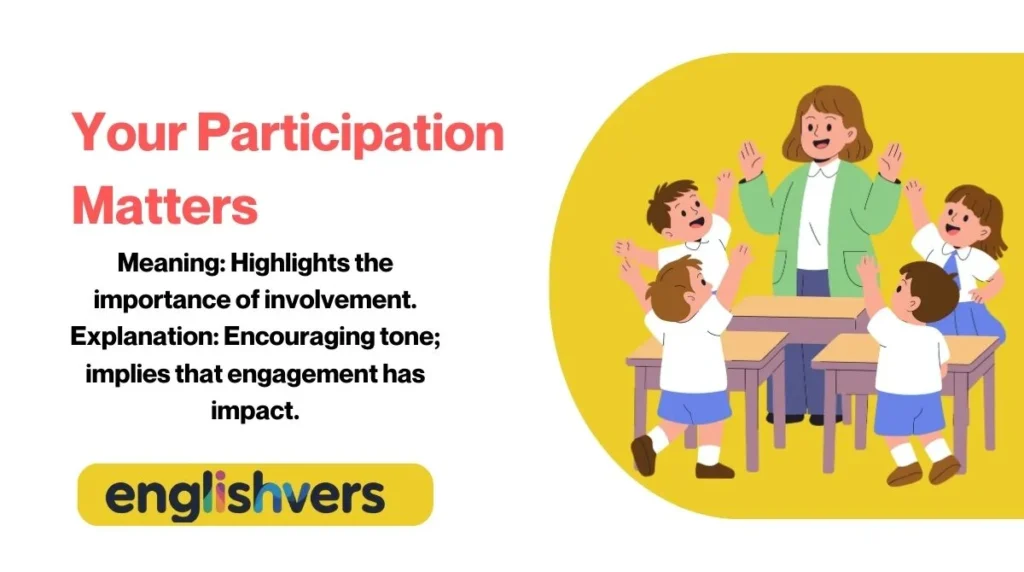
Meaning: Highlights the importance of involvement.
Explanation: Encouraging tone; implies that engagement has impact.
Grammar Note: Declarative sentence
Example Sentence: Your participation matters to the success of this campaign.
Best Use: Corporate meetings, social campaigns
Worst Use: Casual small talk
Tone: Encouraging, polite
Level: Intermediate
Similarity Score: 8/10
Replaceability Tip: Use when motivating participants.
5. Thanks for Contributing
Meaning: Simple acknowledgment of effort.
Explanation: Slightly informal; focuses on action taken.
Grammar Note: Verb phrase
Example Sentence: Thanks for contributing to the team discussion yesterday.
Best Use: Workplace, informal emails
Worst Use: Highly formal letters
Tone: Neutral-friendly
Level: Beginner
Similarity Score: 9/10
Replaceability Tip: Best for emails or meetings where informal tone is acceptable.
6. We Value Your Involvement
Meaning: Shows appreciation for active participation.
Explanation: Formal and professional, often used in corporate communication.
Grammar Note: Formal phrase
Example Sentence: We value your involvement in the project’s planning stage.
Best Use: Business, professional emails
Worst Use: Text messages to friends
Tone: Professional, polite
Level: Intermediate
Similarity Score: 9/10
Replaceability Tip: Use to emphasize the significance of participation.
7. Appreciated Your Effort
Meaning: Acknowledges work put in.
Explanation: Friendly, slightly less formal; focuses on effort rather than mere presence.
Grammar Note: Past-tense verb phrase
Example Sentence: Really appreciated your effort during the workshop.
Best Use: Workplace messages, team chats
Worst Use: Academic writing
Tone: Friendly, polite
Level: Beginner
Similarity Score: 7/10
Replaceability Tip: Use for peer-to-peer communication.
8. Many Thanks for Joining
Meaning: Polite acknowledgment for attendance or participation.
Explanation: Formal but warm; ideal for emails or event follow-ups.
Grammar Note: Formal phrase
Example Sentence: Many thanks for joining our webinar yesterday.
Best Use: Emails, professional meetings
Worst Use: Informal conversations
Tone: Formal, courteous
Level: Intermediate
Similarity Score: 8/10
Replaceability Tip: Use for formal event-related communication.
9. Your Input Was Invaluable
Meaning: Expresses deep appreciation for ideas or feedback.
Explanation: Strongly formal; emphasizes significance of contribution.
Grammar Note: Formal expression
Example Sentence: Your input was invaluable in shaping the project proposal.
Best Use: Corporate, academic, professional emails
Worst Use: Casual or social conversations
Tone: Professional, strong
Level: Advanced
Similarity Score: 8/10
Replaceability Tip: Use when feedback had critical importance.
10. Thanks for Being Involved
Meaning: Casual acknowledgment of participation.
Explanation: Friendly, informal, shows personal appreciation.
Grammar Note: Verb phrase
Example Sentence: Thanks for being involved in organizing the charity event!
Best Use: Social events, team-building
Worst Use: Formal business emails
Tone: Friendly
Level: Beginner
Similarity Score: 7/10
Replaceability Tip: Use for casual or team settings.
11. Appreciate Your Collaboration
Meaning: Recognizes teamwork and cooperative effort.
Explanation: Polished, formal expression; ideal in business contexts.
Grammar Note: Verb phrase, professional
Example Sentence: We appreciate your collaboration on the marketing strategy.
Best Use: Workplace, professional emails
Worst Use: Informal texts
Tone: Professional, polite
Level: Intermediate
Similarity Score: 9/10
Replaceability Tip: Use when emphasizing joint effort.
12. Thank You for Your Support
Meaning: Acknowledges backing, help, or encouragement.
Explanation: Neutral, formal or informal depending on context.
Grammar Note: Formal phrase
Example Sentence: Thank you for your support throughout the project.
Best Use: Emails, meetings, academic, workplace
Worst Use: Rarely inappropriate
Tone: Polite, neutral
Level: Beginner
Similarity Score: 10/10
Replaceability Tip: Perfect default alternative; very safe and versatile.
Mini Dialogue Examples
Formal Dialogue:
- Manager: Thank you for your participation in the strategy meeting.
- Team Member: It was my pleasure; I’m glad I could contribute.
Informal Dialogue:
- Friend 1: Thanks for taking part in the game night!
- Friend 2: No worries! Had a lot of fun.
Business Email Example:
Subject: Appreciation for Your Contribution
Dear Mr. Ahmed,
Thank you for your participation in the client presentation yesterday. Your insights were invaluable and helped us address critical points effectively.
Best regards,
Sara Khan
Mistakes to Avoid (Common Learner Errors)
- Using “thank you for your participation” in casual text messages.
- Overusing the phrase in the same email or speech.
- Misplacing it at the beginning of an email without context.
- Confusing it with “thanks for your attention” (different meaning).
- Using it sarcastically, which can appear rude.
- Combining it with overly informal emojis in professional emails.
- Ignoring audience tone—too formal in casual settings or too casual in formal emails.
Cultural & Tone Tips
- UK English: Often more formal; “We appreciate your contribution” is preferred.
- US English: Friendly tone acceptable; “Thanks for joining” works well in business casual settings.
- Casual Social English: Shorter, personal phrases like “Thanks for coming” or “Really appreciate it” are natural.
- Native speakers value sincerity; repetition without variation may feel robotic.
Comparison Table (5 Best Alternatives)
| Phrase | Tone | Best Context | Professional Level | Example |
|---|---|---|---|---|
| We appreciate your input | Formal | Meetings, emails | Intermediate | We appreciate your input during the project review. |
| Your input was invaluable | Strong | Corporate, academic | Advanced | Your input was invaluable in finalizing the proposal. |
| Thanks for taking part | Friendly | Social events | Beginner | Thanks for taking part in the charity run! |
| We value your involvement | Polite | Workplace, professional emails | Intermediate | We value your involvement in planning the campaign. |
| Thank you for your support | Neutral | Emails, meetings | Beginner | Thank you for your support throughout the project. |
FAQs
Is “thank you for your participation” rude?
No, it is always polite and professional.
Is it okay in emails?
Yes, especially in formal or professional emails.
What is the most formal alternative?
“Your input was invaluable” is highly formal and professional.
What is the most polite alternative?
“We appreciate your input” is polite and safe for most contexts.
What should beginners use?
“Thanks for joining” or “Thank you for your support” are easy to use.
Can it be used in casual conversation?
Yes, but more informal phrases like “Thanks for taking part” work better.
Conclusion
Using varied expressions instead of sticking to “thank you for your participation” improves clarity, tone, and professionalism.
Different alternatives allow speakers and writers to match context, audience, and intent, making communication more natural and engaging.
Practicing these phrases in real-life conversations, emails, and meetings helps build confidence, ensures politeness, and enhances overall fluency in English.
By exploring these 27+ alternatives, you can express gratitude effectively while maintaining the right level of formality and warmth.

Ethan Cole is a passionate language enthusiast dedicated to making English learning simple and enjoyable.