

Strong communication is a core skill in work, relationships, and everyday life.
The phrase “please let me know if you need anything else” is a common expression used to show support, offer help, and keep conversation open.
However, using the same expression repeatedly may sound robotic, scripted, or less sincere.
Your choice of words affects clarity, tone, politeness, confidence, and professionalism. The way you phrase an offer can either build trust—or weaken it.
For example:
Formal: If you require further clarification, I would be happy to assist.
Informal: Just message me if you need anything.
Using varied language makes communication richer.
It helps in business emails, customer service, academic work, client conversations, and casual chats.
This guide teaches formal, professional, polite, friendly, modern, and casual alternatives so English learners and professionals sound natural and confident.
What the Expression Means
“Please let me know if you need anything else” means the speaker is offering additional help, support, or information and is open to further communication. It functions as a polite request and an invitation for further action.
Grammar Form:
A polite request / conditional phrase.
Simple synonyms:
Tell me – Inform me – Update me – Reach out – Contact me anytime.
Opposite tone:
“No more help is available,” “That’s all I can do,” “This is final.”
Example sentences:
- Please let me know if you need anything else regarding your order.
- Feel free to ask if you still have questions.
When to Use It
Spoken English:
Great for helpful conversations—giving directions, offering support, customer service.
Business English:
Used to maintain professionalism with clients, customers, coworkers, and leadership.
Emails / Messages:
Ideal to close emails politely and signal the conversation may continue.
Social Media:
Useful for brand replies, community comments, and support messages.
Academic Writing:
Appropriate when advising students, sharing research, asking for feedback, or offering office hours.
Professional Meetings:
Good verbal closing phrase when finishing presentations or Q&A.
Is It Polite or Professional?
The phrase is polite, professional, and customer-friendly. It is commonly used in emails, phone calls, and support interactions because it shows:
- Openness
- Respect
- Willingness to help
Tone Levels:
- Polite: Yes
- Neutral: Yes
- Strong: No
- Soft: Yes
Formal vs Informal Tone
Formal:
Do not hesitate to contact me if you require further assistance.
Informal:
Let me know if you need anything else!
Etiquette Tip
Use formal versions in job applications, corporate emails, and communication with clients.
Avoid overly casual phrases in professional communication.
Pros & Cons of Using the Phrase
✔ Pros:
- Friendly
- Easy to understand
- Customer-focused
- Clear invitation to communicate
✘ Cons:
- Overused in emails and templates
- Can sound scripted
- Some situations need stronger language
- Not suitable when a strict boundary is needed
Quick List: Short Alternatives (One-Line Replacements)
- Feel free to reach out.
- Let me know if you have more questions.
- I’m here if you need help.
- Don’t hesitate to ask.
- Reach out anytime.
- I’d be happy to help further.
- Just send me a message.
- Contact me if needed.
- Let me know how I can assist.
- I’m available if required.
- Tell me if anything comes up.
- Always happy to support.
- Keep me posted.
- I’m only one message away.
- You can rely on me for help.
- I’m here for anything else.
- Message me anytime.
- I’ll be glad to assist further.
- If something changes, inform me.
- Let me know how it goes.
12 Strong Alternatives (With Explanation + Tone)
Each includes meaning, usage, example, tone, and best/worst context.
“Feel free to reach out.”
Meaning:
You can contact me without worry or hesitation.
Explanation:
Warm, friendly, modern. Good for text, email, or talking.
Grammar Note:
Common casual invitation phrase.
Example:
Feel free to reach out if you need support choosing a service.
Best Use:
Customer service, professional reply, friendly work chat.
Worst Use:
Legal letters or strict notices.
Tone: Friendly
Level: Beginner
Similarity: 7/10
Replaceability Tip: Use when you want a relaxed but polite tone.
“I’m here if you need anything.”
Meaning:
I’m available for help.
Explanation:
Simple emotional support phrase.
Grammar Note:
Informal supportive statement.
Example:
I’m here if you need anything during the transition.
Best Use:
Personal, supportive, emotional situations.
Worst Use:
Formal workplace emails.
Tone: Soft
Level: Beginner
Similarity: 8/10
Replaceability Tip: Use in empathy-focused conversations.
“Let me know if you have any other questions.”
Meaning:
Ask me if something is unclear.
Explanation:
Direct, information-focused.
Grammar Note:
Question-based request.
Example:
Let me know if you have any other questions about the process.
Best Use:
Teaching, customer service.
Worst Use:
Emotional conversations.
Tone: Neutral
Level: Beginner
Similarity: 9/10
Replaceability Tip: Use when answering FAQs.
“I’d be happy to provide further assistance.”
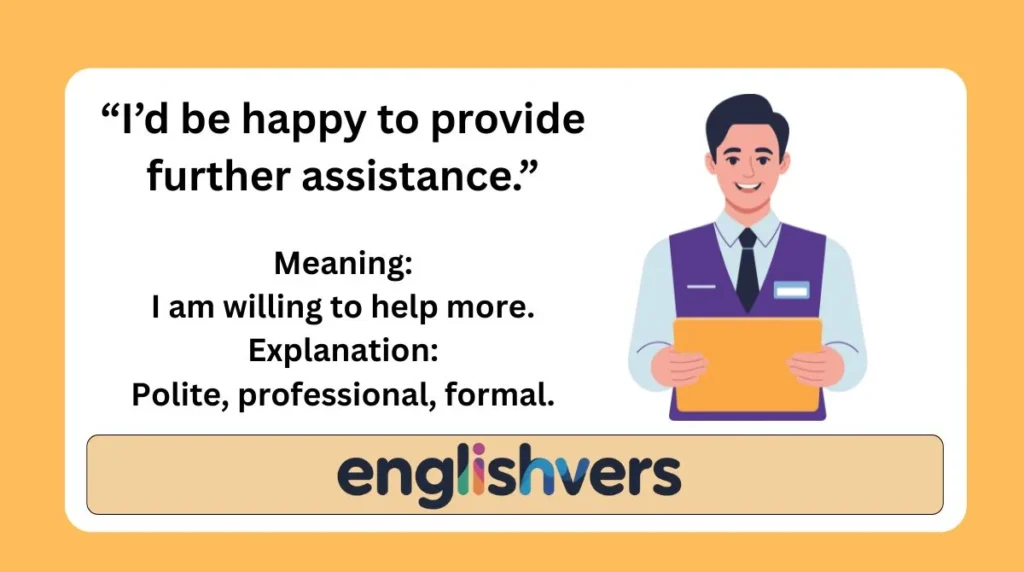
Meaning:
I am willing to help more.
Explanation:
Polite, professional, formal.
Grammar Note:
Conditional formal phrase.
Example:
I’d be happy to provide further assistance regarding your application.
Best Use:
Corporate email, professional clients.
Worst Use:
Quick chats, text messages.
Tone: Formal
Level: Intermediate
Similarity: 8/10
Replaceability Tip: Use when positioning yourself professionally.
“Don’t hesitate to ask.”
Meaning:
Do not feel shy or unsure to ask.
Explanation:
Encouraging and welcoming.
Grammar Note:
Negative command form but positive meaning.
Example:
Don’t hesitate to ask if something is unclear.
Best Use:
Workshops, teaching, communication roles.
Worst Use:
Very formal documents.
Tone: Friendly–Polite
Level: Beginner
Similarity: 7/10
Replaceability Tip: Good when inviting questions.
“I’m only a message away.”
Meaning:
You can easily contact me.
Explanation:
Modern digital communication phrase.
Grammar Note:
Metaphoric expression.
Example:
If you need support, I’m only a message away.
Best Use:
Social media, texting, informal customers.
Worst Use:
Traditional business.
Tone: Casual–Warm
Level: Intermediate
Similarity: 6/10
Replaceability Tip: Use in online communities or customer groups.
“Please reach out if you need any additional information.”
Meaning:
Contact me for more details.
Explanation:
Serious and clear for formal contexts.
Grammar Note:
Formal request structure.
Example:
Please reach out if you need any additional information for the proposal.
Best Use:
Corporate, legal, HR, academic.
Worst Use:
Friendly conversations.
Tone: Professional
Level: Advanced
Similarity: 9/10
Replaceability Tip: Ideal in reports and documents.
“Kindly inform me if there is anything more I can do.”
Meaning:
Please tell me if further action is needed.
Explanation:
Very polite and respectful.
Grammar Note:
Formal polite verb.
Example:
Kindly inform me if there is anything more I can do to assist.
Best Use:
International business, formal culture settings.
Worst Use:
Casual texting.
Tone: Very Formal
Level: Advanced
Similarity: 8/10
Replaceability Tip: Great for communicating across cultures.
“Let me know how I can assist further.”
Meaning:
Tell me what help you need next.
Explanation:
Direct yet polite.
Grammar Note:
Conditional support statement.
Example:
Let me know how I can assist further with the onboarding.
Best Use:
Client projects.
Worst Use:
Teen texting.
Tone: Professional
Level: Intermediate
Similarity: 8/10
Replaceability Tip: Use when tasks may continue.
“I’m available if required.”
Meaning:
You may contact me if you need to.
Explanation:
Short, firm, more formal.
Grammar Note:
Passive supportive phrase.
Example:
I’m available if required during the review period.
Best Use:
Meetings, planning, projects.
Worst Use:
Customer service warmth.
Tone: Neutral
Level: Advanced
Similarity: 6/10
Replaceability Tip: Use when contact is optional.
“Keep me posted.”
Meaning:
Update me.
Explanation:
Casual, friendly, conversational.
Grammar Note:
Informal idiom.
Example:
Keep me posted about any changes.
Best Use:
Colleagues, teamwork, friends.
Worst Use:
Formal written documents.
Tone: Informal
Level: Intermediate
Similarity: 5/10
Replaceability Tip: Use when expecting updates.
“I’ll be glad to support you further.”
Meaning:
I’m happy to help more.
Explanation:
Warm and professional.
Grammar Note:
Future supportive statement.
Example:
I’ll be glad to support you further as you work through the feedback.
Best Use:
Customer service, leadership, coaching.
Worst Use:
Very casual chats.
Tone: Supportive
Level: Intermediate
Similarity: 7/10
Replaceability Tip: Use in encouraging environments.
Mini Dialogue Examples
Formal:
A: Thank you for reviewing the document.
B: My pleasure. Kindly inform me if there is anything more I can do.
Informal:
A: Got the notes you sent!
B: Awesome! Keep me posted if you need anything else.
Business Email Example:
Thank you for attending the training session.
Please reach out if you need any additional information or clarification.
Mistakes to Avoid
- Mixing formal and slang in the same message (“Let me know bro”)
- Using too many adjectives (“very extremely truly helpful”)
- Sounding forced or dramatic
- Offering help when you cannot give it
- Using informal tone in official requests
- Forgetting punctuation—tone changes without it
- Copy-pasting the same line in every email
Cultural & Tone Tips
US English:
Friendly customer-forward tone preferred.
UK English:
Slightly more reserved; formal alternatives valued.
Casual social English:
Short phrases like Reach out anytime! feel natural and warm.
Comparison Table of Best Alternatives
| Phrase | Tone | Best Context | Professional Level | Example |
|---|---|---|---|---|
| Feel free to reach out | Friendly | Customer reply | Beginner | Feel free to reach out with questions. |
| Kindly inform me | Formal | Documents | Advanced | Kindly inform me when done. |
| I’d be happy to assist further | Professional | Emails | Intermediate | I’d be happy to assist further. |
| Keep me posted | Informal | Teams | Intermediate | Keep me posted on changes. |
| I’m only a message away | Warm | Social media | Beginner | I’m only a message away! |
| Please reach out for additional information | Professional | Reports | Advanced | Please reach out for details. |
FAQs
Is “please let me know if you need anything else” rude?
No, it is polite.
Is it okay in emails?
Yes. It is widely accepted.
What is the most formal alternative?
Kindly inform me if further assistance is required.
What is the most polite alternative?
I’d be happy to provide further assistance.
What should beginners use?
Feel free to reach out.
Is it used in spoken English?
Yes, especially in service and help situations.
Conclusion
Using varied language shows confidence, clarity, and strong communication skills. Choosing the right phrase improves professionalism, trust, and tone.
By applying these alternatives in real emails and conversations, English learners sound more natural and fluent.
Practice them in daily life—customer service, workplace communication, school writing, presentations, and social messages.
The more you use these alternatives, the more naturally they will become part of your vocabulary.

