

Saying “sorry for keeping you waiting” is a polite way to acknowledge a delay in communication or response.
It shows respect for the other person’s time and helps maintain a positive impression. However, using the same phrase repeatedly can sound repetitive or even unprofessional in certain contexts.
Choosing the right alternative is crucial for clear, polite, and context-appropriate communication.
In emails, professional messages, casual chats, or academic writing, selecting the right expression can convey the right level of apology, friendliness, or formality.
For instance, in a formal email, you might write, “I apologize for the delay in responding to your message.
” In contrast, in an informal chat with a friend, “Sorry I made you wait!” works perfectly.
Understanding alternatives ensures your message is precise, polite, and suitable for the situation.
What Does “Sorry for Keeping You Waiting” Mean?
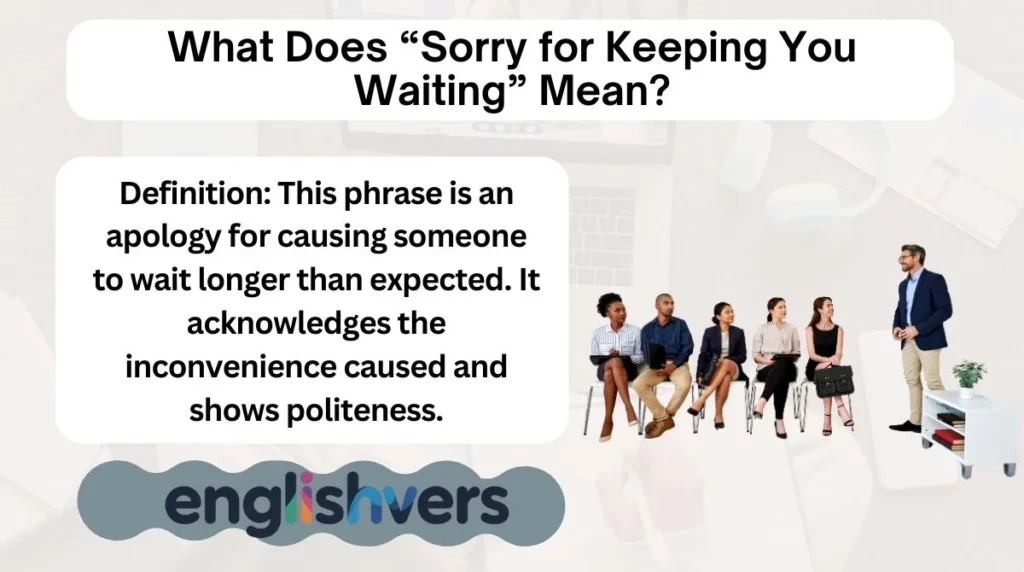
Definition: This phrase is an apology for causing someone to wait longer than expected. It acknowledges the inconvenience caused and shows politeness.
Grammar Form:
- Verb phrase (sorry = interjection/adjective, keeping = present participle, you waiting = object + verb form).
Synonyms / Similar Expressions:
- “Apologies for the delay” (formal)
- “Thanks for your patience” (polite, neutral)
- “My bad for keeping you waiting” (informal, casual)
Opposite Tones:
- Ignoring the delay (rude, neutral)
Example Sentences:
- Formal: “I sincerely apologize for keeping you waiting during the meeting.”
- Informal: “Sorry for keeping you waiting, I got stuck in traffic.”
When to Use “Sorry for Keeping You Waiting”
Spoken English: In casual conversations, you can use it when meeting friends or colleagues who waited for you.
Business English: Appropriate when delays occur in meetings, calls, or project responses. Shows accountability.
Emails / Messages: Perfect for starting an email after delayed responses. Also suitable in instant messaging for professional contexts.
Social Media: Can be used informally when replying to comments or DMs after a delay.
Academic Writing: Rarely used in essays but may appear in communication with teachers, tutors, or collaborators.
Professional Meetings: Appropriate when you arrive late or cause a delay in starting discussions.
Is “Sorry for Keeping You Waiting” Polite or Professional?
Tone Levels:
- Polite: Shows respect and acknowledgment.
- Neutral: Acceptable in most casual contexts.
- Soft: Conveys mild regret.
- Strong: If repeated excessively, it may seem over-apologetic.
Formal vs Informal:
- Better for workplace emails and meetings.
- Avoid in highly formal documents unless necessary.
Pros & Cons of Using “Sorry for Keeping You Waiting”
✔ Pros:
- Polite acknowledgment
- Easy to understand
- Universal in professional and casual settings
- Shows consideration for others’ time
✘ Cons:
- Can sound repetitive
- Less formal than “I apologize for the delay”
- May seem casual in highly professional contexts
Quick Alternatives List (One-Line Phrases)
- “Apologies for the delay.”
- “Thanks for your patience.”
- “I appreciate your waiting.”
- “I regret the delay.”
- “Pardon the wait.”
- “Sorry for the hold-up.”
- “Thank you for waiting.”
- “My apologies for keeping you waiting.”
- “Sorry I kept you waiting.”
- “Thank you for your understanding.”
- “Excuse the delay.”
- “I’m sorry for the inconvenience.”
- “I apologize for the wait.”
- “Thanks for bearing with me.”
- “Sorry for the late reply.”
12 Alternatives with Full Explanation
1. Apologies for the Delay
Meaning: A formal way to acknowledge a late response.
Explanation: Polite, professional, suitable in emails, reports, or messages. Conveys accountability without being emotional.
Grammar Note: Formal phrase
Example Sentence: “Apologies for the delay in sending the report.”
Best Use: Email, workplace
Worst Use: Casual chat with friends
Tone: Formal / Professional
Level: Intermediate
Similarity Score: 9
Replaceability Tip: Use when you need professional formality.
2. Thank You for Your Patience
Meaning: Expresses gratitude instead of direct apology.
Explanation: Softens the apology, conveys appreciation, polite in customer service or professional email.
Grammar Note: Phrase
Example Sentence: “Thank you for your patience while I gathered the necessary documents.”
Best Use: Email, workplace, social media
Worst Use: Casual friend chat
Tone: Polite / Professional / Soft
Level: Beginner
Similarity Score: 7
Replaceability Tip: Use when you want gratitude to overshadow the delay.
3. Pardon the Wait
Meaning: Slightly formal, concise apology.
Explanation: Neutral tone, suitable for brief delays or quick messages.
Grammar Note: Idiomatic phrase
Example Sentence: “Pardon the wait; your order is ready now.”
Best Use: Service, workplace
Worst Use: Academic writing
Tone: Polite / Neutral
Level: Beginner
Similarity Score: 8
Replaceability Tip: Use in short messages or announcements.
4. Sorry for the Hold-Up
Meaning: Informal apology for a minor delay.
Explanation: Casual, conversational, works for friends or internal teams.
Grammar Note: Idiomatic phrase / informal
Example Sentence: “Sorry for the hold-up; the traffic was terrible.”
Best Use: Informal chat, social media
Worst Use: Formal emails
Tone: Friendly / Informal
Level: Beginner
Similarity Score: 9
Replaceability Tip: Use among friends or colleagues.
5. I Apologize for the Wait
Meaning: Formal and direct apology.
Explanation: Suitable for customer service, professional emails, meetings.
Grammar Note: Verb phrase
Example Sentence: “I apologize for the wait during your appointment.”
Best Use: Formal email, workplace
Worst Use: Casual conversation
Tone: Formal / Professional
Level: Intermediate
Similarity Score: 10
Replaceability Tip: Ideal in emails where professionalism is key.
6. Thanks for Bearing With Me
Meaning: Acknowledges inconvenience and thanks the other person.
Explanation: Polite and slightly casual. Can be used in emails or casual conversations.
Grammar Note: Idiomatic phrase
Example Sentence: “Thanks for bearing with me while I resolved the issue.”
Best Use: Workplace, email, casual chat
Worst Use: Academic writing
Tone: Polite / Friendly
Level: Intermediate
Similarity Score: 8
Replaceability Tip: Use when patience is involved.
7. Excuse the Delay
Meaning: Polite apology for a delay.
Explanation: Short, professional, slightly old-fashioned but effective.
Grammar Note: Phrase / formal
Example Sentence: “Excuse the delay in responding to your query.”
Best Use: Email, letters, official communication
Worst Use: Informal conversation
Tone: Formal / Polite
Level: Intermediate
Similarity Score: 9
Replaceability Tip: Use for concise formal apologies.
8. I’m Sorry I Kept You Waiting
Meaning: Personal, direct apology.
Explanation: Slightly informal but still polite; suitable in email and verbal apologies.
Grammar Note: Verb phrase
Example Sentence: “I’m sorry I kept you waiting for the meeting.”
Best Use: Email, workplace, social conversation
Worst Use: Overly formal reports
Tone: Friendly / Polite
Level: Beginner
Similarity Score: 10
Replaceability Tip: Best for casual professional situations.
9. Apologies for the Inconvenience
Meaning: Formal, professional apology.
Explanation: Emphasizes impact rather than just delay. Suitable in customer service and corporate emails.
Grammar Note: Formal phrase
Example Sentence: “Apologies for the inconvenience caused by the system downtime.”
Best Use: Professional, workplace
Worst Use: Casual conversation
Tone: Formal / Neutral
Level: Advanced
Similarity Score: 8
Replaceability Tip: Use when highlighting impact, not just timing.
10. I Regret the Delay
Meaning: Strong formal apology.
Explanation: Emphasizes personal responsibility. Suitable in formal letters, legal, or academic contexts.
Grammar Note: Verb phrase
Example Sentence: “I regret the delay in submitting the documentation.”
Best Use: Formal email, letters
Worst Use: Informal chat
Tone: Formal / Professional
Level: Advanced
Similarity Score: 9
Replaceability Tip: Use for high-stakes or formal situations.
11. Apologies for Keeping You Waiting
Meaning: Direct formal apology, similar to original phrase.
Explanation: Polite, professional, versatile in emails and meetings.
Grammar Note: Verb phrase
Example Sentence: “Apologies for keeping you waiting; we are ready to start now.”
Best Use: Email, meetings, workplace
Worst Use: Informal texting
Tone: Formal / Polite
Level: Intermediate
Similarity Score: 10
Replaceability Tip: Safe alternative in most contexts.
12. Sorry for the Late Response
Meaning: Apologizes for a delayed reply.
Explanation: Ideal for emails and messages. Polite and professional.
Grammar Note: Verb phrase
Example Sentence: “Sorry for the late response, here are the requested files.”
Best Use: Email, professional messaging
Worst Use: Face-to-face waiting scenarios
Tone: Professional / Polite
Level: Beginner
Similarity Score: 10
Replaceability Tip: Use in delayed email responses.
Mini Dialogue Examples
Formal Dialogue:
- A: “We were waiting for the updated report.”
- B: “Apologies for the delay. The report is ready now.”
Informal Dialogue:
- A: “You’re late!”
Business Email Example:
- Subject: Update on Project Timeline
- “Dear Mr. Smith,
Apologies for keeping you waiting on the project update. The revised timeline is attached.
Best regards,
Jane Doe”
Mistakes to Avoid
- Overusing the phrase in the same conversation
- Using casual alternatives in highly formal emails
- Forgetting to thank the person for their patience
- Using “sorry” too many times, weakening the apology
- Using idioms unknown to the reader
- Confusing informal and formal alternatives
Cultural & Tone Tips
- UK English: Polite, understated tone is preferred; “apologies” is common.
- US English: Direct apologies are acceptable; “sorry for the delay” works well.
- Casual Social English: Informal phrases like “my bad” or “sorry for the hold-up” are acceptable.
- Professional Tone: Stick to formal phrases like “apologies for the delay” or “I apologize for the wait.”
Comparison Table of Best Alternatives
| Phrase | Tone | Best Context | Professional Level | Example |
|---|---|---|---|---|
| Apologies for the Delay | Formal | Email, report | High | “Apologies for the delay in sending the report.” |
| Thank You for Your Patience | Polite | Email, customer service | Medium | “Thank you for your patience while I resolved the issue.” |
| Pardon the Wait | Neutral | Service, quick updates | Medium | “Pardon the wait; your order is ready.” |
| Sorry for the Hold-Up | Friendly | Informal chat | Low | “Sorry for the hold-up, traffic was bad.” |
| I Apologize for the Wait | Formal | Email, meetings | High | “I apologize for the wait during your appointment.” |
FAQs
Is “sorry for keeping you waiting” rude?
No, it’s polite and acknowledges the delay.
Is it okay in emails?
Yes, but formal alternatives may be better in professional emails.
What is the most formal alternative?
“I apologize for the delay.”
What is the most polite alternative?
“Thank you for your patience.”
What should beginners use?
“Sorry I kept you waiting” or “Sorry for the late reply.”
Can it be used in casual chat?
Yes, especially informal alternatives like “Sorry for the hold-up.”
Conclusion
Using varied expressions instead of repeating “sorry for keeping you waiting” improves communication in emails, meetings, and casual conversations.
Alternatives allow you to convey the right level of politeness, professionalism, and friendliness.
Practicing these expressions in real-life situations helps learners gain confidence, enhance clarity, and maintain positive impressions.
Choosing the right phrase ensures your messages are respectful, appropriate, and effective across different contexts.

Ethan Cole is a passionate language enthusiast dedicated to making English learning simple and enjoyable.